Showing posts with label MrAShinYRDSB. Show all posts

Saturday, 22 October 2016

Grade 9 math - Part Deux - Improving Retention through Spiraling and Descriptive Feedback

Every year I complain to myself quietly about two things:  1)  lack of retention and 2) kids at this school only care about marks, and not about learning.

Yes, yes, I know - at least they care about something.  I am lucky to be at a school where they care about school, whether it's extrinsically about marks or intrinsically about learning.

However, these are two problems that I would like to solve.

Retention

Quite often, what I taught in September was entirely forgotten about by the time January came; I saw this in some of my 9 academic/11 university-preparation students who did their homework everyday.  For 9 applied students who are less likely to do their homework, retention would become a bigger  issue in my class.  I looked around online and found that some people were also trying to solve the problem of lack of retention through designing the curriculum in a spiral.  Unlike the linear curriculum that I still prefer to implement for my academic/university prep students (maybe it will change), this style of curriculum allows my applied students to see math concepts a couple times repeated throughout the semester, sometimes in a different light  or through a different problem.  The hope was that by seeing the concepts repeated tweaked in a slightly different way after a few times with weeks separated in between, retention would increase.

Learning vs Attaining Marks

This year, while I am still spiraling, it led to the use of descriptive feedback only.  I had a discussion a couple of years ago with a colleague at Trudeau about a situation where if a student scored better on their exam than their term mark, I should consider making their final mark their exam mark.  Their argument was that if a student can demonstrate their learning by the end of the course, it doesn't matter that they couldn't do it in September.  I still am not fully convinced, as I believe that throughout the term there are other pieces like "thinking" or "communication" which are more fairly evaluated when there is more time than a 1.5 hour exam.  However, the colleague still had a key point that I could not shake off - the learning cycle ends with an exam and if students can demonstrate their knowledge and understanding by that time, that should be all that matters.   

Quite often when my students receive a their test, they always look at the mark first before any descriptive feedback.  While the majority of my students react to the actual mark first, there are fewer students that can get past that initial reaction to read the descriptive feedback and actually learn. This makes sense for a student because the test is a natural end and judgement to the learning cycle of a unit or a spiral.

So, I decided to try descriptive feedback only for the first half of the semester to extend the learning cycle.  This emphasizes to them that the first 1 or 2 spirals through the curriculum would be about learning only.  As a result, the principal and the superintendent have given me permission to give "I" as opposed to any marks on the report card for my students for both the interim and midterm report cards.  This has given its own sets of problems as my students really want to know how they're doing in terms of a mark.  I am trying to emphasize to them that learning as much as you can is all that you should be worried about at this time.

I just want to leave you with this final quote from my student.  The context was this - it was September when I was having trouble convincing my own students that there wouldn't be any marks.  There was a general consensus among the twenty of them that they would actually want marks just to know where they are.  I was about to lose them when one of my students said: "I get it now...school becomes more about learning than it is about passing."  All the students had an 'aha' moment given to them from another student.  It was one of the more impressive 'aha' moments I have witnessed in my 10 year career...and I wasn't the source of it.  What's more interesting, is that this 'aha' moment was more rewarding than any other.  


Monday, 5 September 2016


I was so pumped after my 3rd teacher workshop of the year that I had to take a picture. 


Earlier this year I did my first math workshop.  Here was the description: 

Are your academic & applied grade 9s disengaged? Learn how other teachers and I transformed our teaching practice utilizing the spiral curriculum to increase retention of math. By using a combination of Dan Meyer's problem-based 3-act math, collaborative white-boarding, and Knowledge Hook's online technology, students are more engaged and rediscover an enjoyment of math. Come and learn how to efficiently implement one or any of these strategies to jump start your classes' retention and engagement! 

I checked quite often (even though I know it was unhealthy to) to see how many people were attracted to my description. It was crushing.  Even on the last day leading up to OAME, there were 3 people who signed up for my session. I managed to console myself by stating that it will be easy and having fewer people is  a good way to start one's first math workshop.  I also managed to convince myself that because it was on a Friday and it was the last session of the day...most people wouldn't come anyway.  So I managed to not take it personally.

Boy was I wrong about the number of people.  I had 30+ show up to my session!  Well, this OAME “Endlessly Spiralling  through Grade 9 Math” was much better than my previous two presentations on “To Blog , where No Blog has Gone Before”. 

There are a couple comparisons that are important to note here:
·         
  • After two workshop presentations, I think I got the hang of it.  I went from a 1-way presenter of  disseminating information to an interactive teacher/facilitator that talked and listened to the audience.  I sometimes would lead a discussion with the audience but also lean on the experience of the audience as well for input or further expertise.  
  • I’ve been using blogging as a tool in the classroom for over a year whereas I’ve been spiraling for only 9 months.  However, I am much more comfortable talking about spiraling in math than I am about the use of blogging in the classroom. 
  • I used Pear Deck many times in the classroom before I did my math presentation vs my blogging presentation. 

Here is some feedback on my presentation.  Looks like about 7 people answered this first question, even though over 20+ attended.  Not everyone fills out feedback forms:    

Leading a discussion with fellow educators and administrators requires a very different than I had developed teaching teenagers. One of the biggest difference I learnt was that there was a curriculum when teaching the students versus no curriculum when at a workshop.  At a workshop, the content discussed better be useful for the audience or else it’s a failure.  In the classroom, the content discussed often isn’t the teacher or student’s choice, so we just have to make the best of it.  As a result, I started my presentation using Pear Deck to interact with the audience.  I used to only use it to get to know where everyone is from, which age group they most affect etc….

This time I used it to ask what they expected out of the workshop.  It became evident as I was browsing through their comments that some of my expectations and their expectations didn’t align.  I went through the list and acknowledged each one of their expectations; I would defer some, promising to get to it later in the presentation, and others I would answer on the spot.   A few questions I wasn’t within the scope of the presentation and I apologized but at the same time used this as a segue to the fact that I wouldn’t get offended if anyone left early.  This portion was informal in nature and opened up the floor quite a bit.  

I spent only 3 hours explicitly preparing for my OAME presentation whereas I spent days preparing for my blogging presentation.  It’s amazing that out of the 7 people that responded, 3 stated that I was ‘somewhat organized’ and 4 stated that I was ‘well-organized’.  However, upon reflection, I’ve actually spent a lot more time preparing for this presentation than the 3 hours beforehand. 

When I went to George Couros’s presentation back in October, he stated that he formatively spent 5 years writing on a blog getting feedback from all sorts of people around the world.  He would get his ideas refined and learnt how to wordsmith. 

Something similar happened to me here – I blogged about spiraling for 7 months beforehand, and I could whip together a presentation in 3 hours and then speak about it in an organized, confident manner the next day.  Normally I would have much trouble talking about my experiences, but blogging helped me refine my thoughts so that when I spoke, it wasn’t a big jumble.  

Wow.  I was thinking that OAME was hiding negative feedback at first here, because there seems to be only one person answering these questions now.  However, I looked back up and saw that there is still some negative feedback, so maybe? 

Nevertheless, I guess the respondents finished off the survey at the end, which showed I did an ok job:  3 people said it was ok, 3 people said good, and 2 found my session to be great!  I still have to work on things as only one person would recommend me as a speaker – now I have something to work towards.  Looking back – I have to work on my content.  I am not very knowledgeable about the changing math education.  My goal is to read Jo Boaler’s “Mathematical Mindsets” this summer and hopefully I’ll have a better scope and understanding of what her student Dan Meyer was going towards.    

Except….I forgot to apply to run workshops for 2016/2017 year as ultimate took up my entire life from May to June.  You live and you learn I guess.    On to the next year!  Can't wait to start tomorrow!

Thursday, 7 July 2016

My Grade 9 Academic Review of Mr. Shin

Every year, I ask my grade 9 academic students to review me, and give me my report card.  For a course that I've done a few times, where I don't think I can get as much out of my own reflection, it is important I at least ask the kids to write something.  Then, it forces me to self-evaluate and reflect on some level.

Here it is!

Mr. Shin should:

Start:
Giving more rewards so we can try for food. Food is life.
Add memes to your presentations.
Teaching us lessons for longer periods of time instead of entrance cards  +1
Do more interactive activities because that helped people learn/remember new information
More inquiry questions
More Knowledge hook
Practicing more application questions
Putting multiple choice on exams (I did?)
More interactive stuff
Projects +1
Start using pictures on the computer and technology more often
Use a ruler(joke) 
Check homework more often  +1+1
Check homework without warning
No option for wall sits or detention (always wall sits!  =)  )
Punish students with math problems instead of wallsits/detention
Ask people where they want to sit
Write bigger on board
EQAO review earlier


Stop:
Try not to make as many mistakes or your legs will be too strong (wall sits)
Making us go outside of class to do activities bc I don't want to move
Using technology and could teach us more lessons
Nothing
Wall sits, try burpee insteads
Stop doing one hour long lessons so we can actually try out the work ourselves
Stop using the whole class time on ecards
Shouting
Making mistakes
Making tests hard

Continue:
Being awesome
Teaching
Explaining Concepts
Being enthusiastic in teaching us math +1
Being funny =) +1
wallsits (because they teach you things and it is good discipline)
Being amazing, you really helped me improve this year and I really appreciate it.  Keep up the good work!
Entrance cards +1+1+1+1+1
Using technology in lessons
EQAO practice +1
Partner/Group work +1
Using Google classroom
knowledgehook +1
worksheets
changing seating plans
providing help +1
making puns
using the projector
Making lessons fun

Tuesday, 7 June 2016

Math and Work

Balance.


If there is one thing I've learnt over the years, it's that balance is key.


Teaching math comes out with all sorts of different instructional strategies and technologies.

However, attaining fluency in math is just like anything else - practice is key.  Today's learners are less and less receptive to repetitive drill and grill - which is fine.   Drill and grill is for the assembly line workers of the 1900s.

The way English is taught in schools when I attended was that it was never really explicitly taught.  English was always implicitly a part of the curriculum from what I could remember.  Even grammar.  I was taught English in many different contexts, whether it was experiential by going out to the local fair or interacting with people from other schools in the collaborative learning environment.  Sure, there were some explicit grammar lesson to keep things in balance, but the learning occurred without me even realizing it.

I have been trying to attain this balance in the math classroom with those 3-act problems introduced by Dan Meyer.

Introducing a problem through a vague video is that first step.

Inviting the students for any questions or comments about the video is the hook.  Sometimes those videos are something that they would recognize from their world (ie:  a videogame) or sometimes the video can be about an abstract math concept.  I have to balance the context of the problem with their world and the 'outside' world to both connect with them and also teach them about something outside their world.

Spiraling through the curriculum is also a form of balance.  We stay long enough on a topic such as linear relations to challenge their attention span, but also switch to 2D measurement perimeter and area to keep them engaged.   We provide problems that vary and cross the different strands to show that math is not just one dimensional.

However, after problem solving we must go back to do some focused learning.  Usually in the form of worksheets that focus on a particular skill, I find that students have a little more motivation to practice the skill that we just introduced through the video that we just problem solved.

It's interesting to see them focus on practice and drilling and grilling.

One of my friends, who plays in a band for a living, stated that music and sports are probably the only subjects that students 'practice' anymore, where they are willing to try and do it over and over and over again.

The students still need practice.   I tried to vary the practice in a few different ways - with the use of whiteboards.  The whiteboards are super important as they are MEANT to be erased, which encourages students to try - regardlesss whether or not they fail.

Balancing differentiation.  These are the only two things that I have seen work consistently.  But it's hard to pull it off.


Thursday, 19 May 2016

Kahoot is a Hoot!

One day, one of the students didn't have their presentation ready.  My emergency backup lesson plan was to run a kahoot on random space questions.

Kahoot.it is the latest in clicker software, where students can use any technology whether it is a phone, laptop, ipad, etc.  It's a good thing I was in the 21st century classroom as any student without a mobile device went over and grabbed a laptop or ipad.  

Kahoot measures who gets the answer quickest and awards the fastest student...or teacher in my case.  


However, I didn't always win - the youth that my students have over me was shown in the next game. Their reflexes were much faster. See exhibit B below:


Anyways, I had quite a bit of fun and was fully engaged.  Some students took notice and included a kahoot into their next presentation.  (I lost that one too...but my excuse was that I didn't fully pay attention to content as I was scribbling notes on their presentation as a whole to help provide them with feedback on their next presentation).


Saturday, 23 April 2016

Starting from the Bottom...and Now We're 3rd

Our tier 1 ultimate team went to our first tournament in February, and promptly lost every game we played.  However, there were some good plays and great sharing by the team.  These are good signs as we shared the disc with everyone and swung the disc around from side to side:
The tier 1 team is warming up, and my colleague who has the same last name is excited to be at her first ultimate frisbee tournament.


Another great sign of the future was foreshadowed with this play with great defence from a grade 9 and terrific anticipation by another grade 9 to go for the score.  I'm proud of the way they competed against older and more experienced players:


Our tier 2 team did a little better by losing 4 games and tying the last - but we beat them by spirit points and won the spirit award for the tournament.  This assured that we brought home hardware two years in a row at this Toronto tournament.  Last year we won the tier 2 tourney and this year we got the spirit award, completing the collection.


I could tell this year's chemistry was something spec,ial as we came home from losing every game. Everyone's spirits were high from experiencing ultimate at such a high level.  Our beginning cheer is epic and our final cheer is pretty much always right on point.  It's not complete with the manager playing the guitar!  It was the bus ride home that really got to me - the buzz after a full day's tournament was really strong.  Many people in the bus were playing heads up with each other or having a good conversation.  Some were sleeping (it's a long day) but in general the team was upbeat. 

We practiced hard for the next month with a couple alumni coming into practice for some extra help.  7am morning grinds as well as after school practices got us into the work mode.  We improved a lot, but they couldn't tell....until we entered our next tournament - the Husky Huck. 

We started off the tournament with two strong wins to win our pool.  It was convincing with a balanced attack with points coming from everyone and going to everyone.  No one player dominated the pitch offensively.  It was a treat to watch.  

Our first playoff game was a tough one against a rival in TDCH.  We got down early but came back in the end as we showed great resilience and grit.  We dug deep and believed in ourselves to get back into the game.  Even though we lost, we learnt quite a bit.  

We played for 3rd in our final game and ended victorious.  We made adjustments in our activity level and beat another rival that beat us last year in the playoffs.  And really, I keep mentioning the final result when I believe that those results are just icing on the cake.  The real result is that the players are developing and getting better.  They're learning loads and adjusting well.  We are sharing the disc amongst all players - including the females on the team.  Our females have the confidence to throw forward.  I'm so proud that they've taken the initiative.  

It's considered a genderless sport and I'm trying to champion that.  

I'm also proud of the trust that the males have placed on them by throwing the disc to them and then running ahead to demand for the disc instead of standing behind them asking for a backwards pass.  

The bus ride home was really fun.  The sun was shining and there were no cliques.  Everyone was talking to everyone.  The team was again very upbeat and the mood was happy.  Multiple games of heads up occurred at the front and back of the bus...and even the most quietest of players would take part. 

The captain of the team organized a team dinner 3 weeks ago because she wanted to build the team up.  They played ice breakers and everything to try and break down barriers.  Looks like she succeeded.  

I completed my goal.  It's their team.  They own it.  They're happy.  They learnt a lot.  

I have two managers helping me with the administrivia.  I have two alumni starting to come out more regularly because their 1st year in university is done.  

I could just stop here and be really happy about the team, but we're only halfway through the season. We are starting outdoor season now.  

Fitness time.  

Disc up.  

Saturday, 9 April 2016

Presenting at YRDSB's Edtech Spring

Today I presented to a total of 3 people for the second iteration of "To Boldly Blog where No Blog has Gone Before".  It was quite the different experience compared to my first time I presented for my 2016 QUEST conference with 60+ people from all over the world.


That time I didn't have my slides organized, I was trying to use Pear Deck for the first time, and I didn't know exactly what I wanted to say.  Needless to say, it wasn't very good.

Today, I distilled the presentation down to some key concepts producing an overall better organization. I allowed for some genuine conversation and discussion among the audience (easy to do with 3 people)- which actually allowed me to learn quite a bit.  

I had a senior kindergarten teacher, an intermediate French teacher who is part of the ETFO executive, and a person from the Director's office.  The vastly different perspective on education allowed me learn so much outside of my secondary school niche and it was an incredible exchange of information (at least for me).

As for blogging, the needs of the senior kindergarten teacher were unique and I was able to help her out with the newsletters that will connect with parents directly instead of relying on 3-4 year olds who lose those pieces of paper between the end of school, daycare, and home.  Communicating with the parents who want the constant updates that they used to receive from daycare was another purpose of the blog that I was able to help her with.

                                          Caption:  Edtech 2016 first time presenters!

Overall, this was a great experience as I learned much through the informal conversations as well as trying to meet the needs of my 'students' as they tried to create their own blog that serves its own needs.


Monday, 15 February 2016

Modelling the Expansion of the Universe

When teaching the space portion of this course, there isn't a lot of labs I can do when I compare with the chemistry, biology, or physics teachers.

However, when I do get the chance to do a lab - I'll jump on it.

Here we are, modelling the expansion of the universe with elastics trying to get something similar to Hubble's constant.  Each paperclip represents a galaxy and when you stretch the elastics in between each galaxy, you measure the change in distance from one chosen home galaxy and the others.

Fig 1: I hope they fixed the crooked rulers...

It's a lab that can be done with my grade 9s.  However, the analysis level and connection to the actual expansion of space might not be up to a level that I would like.

I've had some interesting error analysis questions as well as deep questions that strive for true understanding.  (ie:  improvement of measurement in the above picture - ie:  use of tiles? )  What this actually models and how it holds up to current theories about the universe and where it breaks down - all of these are important aspects of the lab that I hope we extract at some point.


Sunday, 14 February 2016

Earth and Space Science - my second year teaching

Second semester has arrived, and that means it's earth and space science time!  This is the second year teaching it, and my goodness, my comfort level with this course has skyrocketed.

It certainly helps that my wife is teaching the same course, and we are learning it at the same time.  On our road trips, we wouldn't listen to music - we would download audiobooks and lectures from Neil Degrasse Tyson and Robert Hazen and get the education we needed in space and earth respectively.  I have read most of Carl Sagan's Cosmos book (thanks to last year's students who bought me that book)  and the textbook that my students use.  I know...my wife and I are both geeks.  But, we both love learning.  Here is the comparison of how I feel from last year compared to this year:

  • I can now elaborate on my slides as opposed to just reading.  
  • I can answer a good percentage of questions that they have.  (at least thus far)
  • The engagement level is much higher, even with a much bigger class of 27. 

It's weird - but I'm changing the way I will teach this.  I understand that the students mostly take this course for space - so I will put all the cosmology stuff at the beginning.  However, with the next 4 strands - I will be spiralling through the curriculum.  I will weave my way starting with a little bit of minerals, to touch upon volcanoes, geologic time in the first spiral.  My second spiral will weave through rocks, more volcanoes, geologic time and and planet formation.  The rest of the spiral organization is laid out with my thought processes here, with each column representing one spiral.


Now that I have tried the spiral curriculum when I taught grade 9 applied math, I know what advantages and disadvantages it has.  I know what content lends itself to each of the linear and spiral curriculum.  

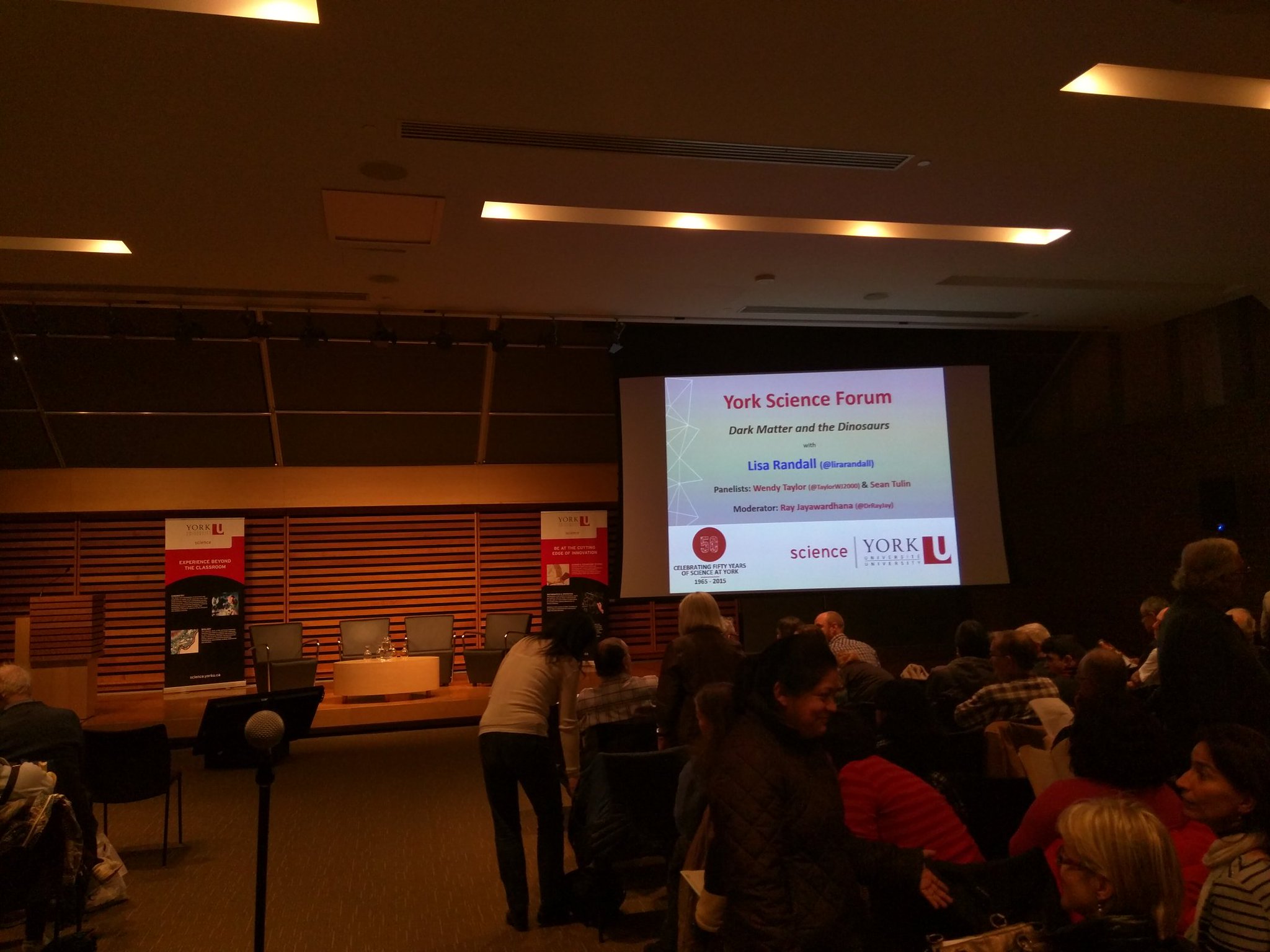
One of the coolest things that I have been emphasizing thus far is the contribution of females to this science. Astronomy and cosmology is a science that we're still learning much about and we certainly don't understand much of it even at this point.  We are still developing tools to study what's way out there.  (Hello gravity waves!)  Females now have more access to education than 200 years ago, and one can see their contributions from Leavitt's discovery between absolute brightness and periodicity between maximum and minimum brightness to today's Lisa Randall's "Dark Matter and the Dinosaurs".  Now that women can touch telescopes and things are opening up for them a little, we will see more and more contributions like Lisa Randall's.  I certainly enjoyed her lecture at the Toronto Reference Library.  

I'll show the Cosmos reboot episode entitled "Sister's of the Sun" by Neil deGrasse Tyson later on this week to show other men and women's contribution to our understanding of space and stars.

My ultimate frisbee team is also asking for more practices and they're getting anxious because they're unfamiliar with the system.  Looks like more 5am wakeups for me!


Sunday, 24 January 2016

Character Education - Honesty with Marks

One of the things that I wonder about as a teacher is the relationship between marks and learning. While this debate can run quite deep with some teachers advocating to do-away with marks entirely and others on the opposing spectrum to anything in between.

 I am going to look at this from the student's perspective.  Especially when it comes to grade 12, many students focus solely on mark grabbing and hopefully learning occurs along the way.  I try to emphasize that if students focus on learning as the priority, then the marks will naturally come.

It's just easier, from the student's point of view, to focus on getting marks first which promotes behaviours that I don't consider 'true learning' such as passing around last year's tests, studying at the last second for the short term memory thing, cheating, and memorizing.    

Some will say it's the teachers' fault for setting up this system.  Others' will fault the universities' inability to sort through candidates other than through marks.  It might be a little from column A and a little from column B, and even from an unknown C that I haven't quite considered. 

The beauty of being a teacher is that in many ways, I control the classroom.  In my little world here, I can highlight and contrast the difference between a mark grabbing student and a student that learns for my own students.  

Every year, at the beginning, my students write a diagnostic that does not count for marks.  When I mark it the multiple choice portion, I purposely:

1)  take away a mark that they deserve 
2)  give them an extra mark that they do not deserve

In the end, their mark stays the same.  However, after I take it up the test and show the marking scheme, I go around individually to each student asking how I should change their mark.

I have found in the two years  that I have done this, many students state that their mark goes up by 1, a few ask to bring down their mark by 1, and many so no change.

I then ask the students to reflect on their action.  I cannot judge what they did because I do not know the rationale behind their action but I take the time to highlight the following:

A)  If you asked me to reduce your mark knowing full well you deserve another mark, then you are too hard on yourself.  You deserve another mark, and should ask for it - after all, you got the answer right as well as another question wrong.

B)  If you asked me to increase your mark by 1 or decrease your mark by 1 because you didn't notice the other mistake I made, then you have to pay attention a little more during test takeup.  This is a time to learn from your mistakes, which is quite often the best time to learn.  Be a little more detail oriented and listen carefully for these are important skills in life. 

C)  If you said "no change" because you didn't notice anything wrong, then you are not paying attention whatsoever.  (I may run the risk of an IEP student that has issues with the delivery, but I do make sure to show the multiple choice answers visually and say the answers aloud for each question so that should cover most minor IEPs.)

D)  A few students say "no change" but have already done their self-reflection on what question was actually right and what question was wrong.  This is fine as well.

E)  Each class, there's always one or two students that tell me explicitly that I marked one question right and one question wrong, showing true transparency to me.  This is awesome, and it is something I tell them I try to do for them as a teacher.

F)  This is the last option I go over.  I've learnt to explain this last option gently as a few of my more sensitive students feel guilty even when they didn't do this.  If a student asks for a +1 in marks knowing full well they should have a no mark change, then I ask these students that find themselves in this position to do some deep reflection.  I state: "You have just lied to me about your mark.  What did I do to you in the last week to deserve this?  (hopefully I did nothing wrong in the past week to start the school year off).  You have just inflated your mark to your parents about your mark.  Above all, you're willing to lie to yourself and pat yourself on the back for getting a higher mark than you deserve.  If you're willing to lie to yourself to inflate your mark, lie to me who has done nothing to you, and even your parents on a diagnostic test that doesn't even count for marks - what are you going to do when it comes to money or other situations?

This year, I delivered my speech well.  I returned a test on January 4th, and made a mistake on a multiple choice question.  This is almost 4 months after my little stunt.

Class 1:  I had 7 students come to for a mark increase. I had 8 students come to me for a 1 mark decrease.

Class 2:  I had 8 students come for a mark increase and 7 marks come for a mark decrease. 

As you can see, grade 9s are very receptive to this sort of thing.

When I pull this stunt with my grade 12s, I get into deep debates with my grade 12 students when I ask them these questions.  The one thing they always bring up is that this mark is so small, it doesn't matter.  From their perspective, this if this one mark occurred on a summative assessment, it would help them in their goal to getting into university and it doesn't hurt anyone.  If it doesn't hurt anyone, why not do it?

We then go back and forth about the fact that if you increase your marks unfairly to get into a university program, you're kicking someone else out of the same university program.


I know deep down that the system will have to change to have any permanent effects, but in the end, it's a fun debate and a good exploration on what honesty really means.  I learn much of my students in this little experiment and I'll probably continue to do it. 

Friday, 22 January 2016

Iterations Improving the Proficiency of my 3-Act Math Delivery

NOTE:  This is a late post - supposed to have been published last month but I've only recently found time (during exams) to post it.

For today's lesson, we turned to Dan Meyer’s video question on which cup contained more juice.  Here's my powerpoint that goes with it:  


It is a splendid 3-act problem that inspired some interesting questions.  However, the quality of their questions has decreased since September; the questions had more depth, and their observations keen.  Now, they are just giving me the question that I am looking for.  Wasn’t the whole point to emphasize the questioning to clearly define problems a little more?  It looks like I’ve fallen hard into my habits and have prized THE answer as opposed to prizing the question and problem definition. 

Wow, blogging really forces me to reflect more than usual.  It just dawned on me that the reason why the question quality has been decreasing since September is that I don’t answer all of their questions.  There were so many quality math questions that were generated by the students from the videos in September but I ignored the most quality ones because they would probably take a day to answer. 

I have placed 100% more importance on following my scheduled spiral curriculum than their curiosity. 

Looking back, I should have made more of a compromise, and actually followed through with at least a few of their questions.

It would show a lot more teacher willingness to venture into the unknown and really value their questions.  Following through to try and answer their questions would actually demonstrate how I learn – one of the most important things to model.   Instead, I’ve trampled on their curiosity and lost that opportunity to be a role model of a real learner. I feel really badly now. 

But, can’t be ruminating now, can we?  I’ll just change it for next semester.

So I’ve digressed.  Going back to the 3-act question:

After receiving their questions, I specified the question that we were going to answer today.  Which cup has more, and by how much? 

Here are their guesses as a completion to act 1: 


It’s interesting to see how many of them chose that cup A and cup B had the same amount. 
Nevertheless, act 2 came along, and with those measurements and the conversion ratio the students went about to work. 

After about 15 minutes of discussion and hard work on large whiteboards, the students put their answers on at the front.  Only 10% of them got the right answer:


 The stumbling point for many students was the CONVERSION!  I have to find another way of teaching conversions as I have been repeating it throughout the year and it still hasn't sunk in. 

In truth, the fact that many of my students weren’t able to complete this question in pairs disappointments me. 

I made this question into an entrance card to repeat for tomorrow in hopes that the students will get it during their second try.

I will take it up and repeat a similar question as an assessment on the next Friday. 


Update:  They did very well on their assessment.  I wonder if they’ve gained any ‘permanent’ skills along the way in this process or if they've just memorized the process.  I will only find out later I guess especially with that EQAO coming up soon.  

EQAO - math standardized test - the time is here..

Wow.  We just finished the EQAO and it looks like it's been quite a success.  The students, according to my marking, have scored the highest they ever have compared to the previous two times I've taught the course.  In their feedback of how they felt about writing the EQAO, the students reported a high level of satisfaction upon completing the test.


The success comes as no surprise as I've never had engagement like this before.  However, it just feels pretty good to have this spiral curriculum and 3 act math pay off.

Well, of course, I think in order to really see if all of this did work, I should compare their grade 6 math EQAO marks to their grade 9 EQAO results to see if I really did make a difference.  We'll have to wait until next year for those results.

I'll just have to wait, then.  


Thursday, 17 December 2015

Ultimate Tryouts

Ultimate Tryouts

For the first time, I will be alone as the only coach.  My other co-coach has too many new responsibilities after moving departments, so it will just be me.  For the past 7 years, I was blessed to have tremendous co-coaches; they have supported me and changed the way I look at this role.  The kids benefit from having that second coach there – it’s evident in their crestfallen faces as I tell them they will no longer be coaching.

I will certainly miss them. 


Tryouts started on the first week of December.  I knew there was going to be quite the interest in trying out for the team; so I made the announcement one day before the first try-out to hopefully limit the numbers.  There was no way I could remember and learn all the students’ names.

I had 4 tryouts and over 70 students, boys and girls come out.  Fortunately, I have two student managers, a willing captain, and four alumni come out.  They helped enormously through the process of modelling and running the tryouts; they had some input into the selection of the team as well.
That last statement alone could cause a stir among traditional coaches who usually shoulder the authority of cutting the team alone.  But I have been a part of too many clubs and have seen the power of involving student executives.  They know it’s their team and have more of a responsibility, and thus buy-in from the start.  It’s helpful to have that sort of buy-in for a ‘season’ of 1 day/week practices for the next 6 months. 


Again – should other students have the influence over choosing other students?  Can they be unbiased from their friends?  I remember when I first did this 2 years ago, my grade 11 execs were quite unbiased, and my ‘exec’ team cut their friends.  They received quite a bit of ‘flack’ from that and apparently they couldn’t handle the aftermath of cutting their friends; the following year when they were grade 12s, they didn’t want any part of the team making process. 

This year, I certainly needed this year’s execs to help out.  Bias is better than missing out on potential talent I guess. We’ll see where this goes – but I believe that since empowering students is the latest in educational trends, I should be ok. 

There is an exceptional group of grade 9 students that came out.  It is rare to see grade 9s already with the basic ability to throw and catch.  Unfortunately, this isn’t the only two things that I look for.  Students don’t seem to understand that when there’s one disc on the field, there are 13 other players on the field without the disc. 

The majority of time, you do NOT have the disc.   I am evaluating what you DO without the disc.  I am evaluating whether or not a player has a growth mindset.  I evaluate how they deal with mistakes. Like this guy here...

      
This is the second year in which I’ve taken a student that has tried out for the past 3 years and has been cut.  They have tried extremely hard to work on their craft and their skill and their physical abilities.  Three years is a long time to keep trying and these two players have stuck out in my mind, even though I will only have coached them for their grade 12 year.  Their perseverance and determination to make the team is absolutely commendable. 

Throwing and catching can be taught as this is an explicit skill that seems to attract most people to throw the disc.  As a result, the majority of my players will work on that skill on their own throughout the year. 

I’d rather work on teamwork and chemistry through offensive and defensive schema. 
Except right now, I am running two teams on my own.  I wasn’t willing to run a team on my own before and would always want someone there with me.  Why am I running two indoor teams when I am the only coach? 


I have an extremely willing student manager named Crystal and another student manager, Stephanie, who just wants to help out.  (names have been changed to protect identity of students) 
What’s interesting is that Crystal has also been cut from the team for the past few years.  She loves the game and has found a way to contribute.  She is now manager and putting to use her administrative and organization skill. 

Our school is filled with spectacular students. 

We will see what happens after the three practices we have in January before the exams.   


Practices are going to be quite interesting with 36 players.

Wednesday, 16 December 2015

Inquiring the Surface Area of a Sphere Through the Peeling of Oranges!

It's getting closer to the winter break, so it was great to have some hands-on activities to add some spice to the classroom for my academics.

It seems like my applied class is getting all the engaging and interesting approaches to math, so this was quite refreshing for myself (and especially these academic kids) to have this tangerine activity to explore the surface area of a sphere.

First thing we did was take a good look at the tangerines and noted its differences from a perfect sphere.  We then went on to talk about how perfect mathematical spheres don't exist in the real world since once one gets into the atomic level, things just aren't continuous.  This sort of statement really bothered some of my students  that one went home and told their parents.

Nevertheless, upon noting the clementines' (lack of) sphere-like properties, we proceeded to take a guess as to its surface area in terms of its radius, and thus area of its 2D ('projection'?)  version.   Each partner made their guess:

Looks like they their estimation skills are almost en par with my applied students' skills which has been honed through the Dan Meyer's 3-act process.  That...or they looked at the formula sheet or remembered the answer from their elementary school days.

Let's see how they did:


 I guess they couldn't be bothered to peel that other portion there to get its true surface area?  I guess I should have done more teaching and less snapping of pictures here, as I could have demonstrated that by peeling the skin into smaller pieces would more accurately depict the surface area.  Right now, much of the 'surface' area is used for the third dimension of height severely downplaying the true surface area of this orange. 

 That clementine there looks quite tasty.  I must mark these students' self regulation skills to be excellent in their ability to stay on task without eating some juicy fruit.


 Now that clementine looks quite symmetrical...and tasty.


Ahh, "four" circles!  The 'true' answer.

Now this group featured a student who made the best notes ever and another student drew some of the best art on evaluations.  The illustrations left behind were both profound and thoughtful.  It's no small wonder that they took the time to rip the orange peels into symmetrical sizes to create the above work of art.

Anyways, this activity proved to be quite memorable.  It's a good one and one that I'll continue to do every time I teach grade 9 as it somewhat demonstrates how the surface area of a sphere is 4Ï€r^2 or the equivalent of the area of four circles.   

Tuesday, 15 December 2015

Capitalizing on the Hour of Code: An Alternative Assessment for Solving Equations

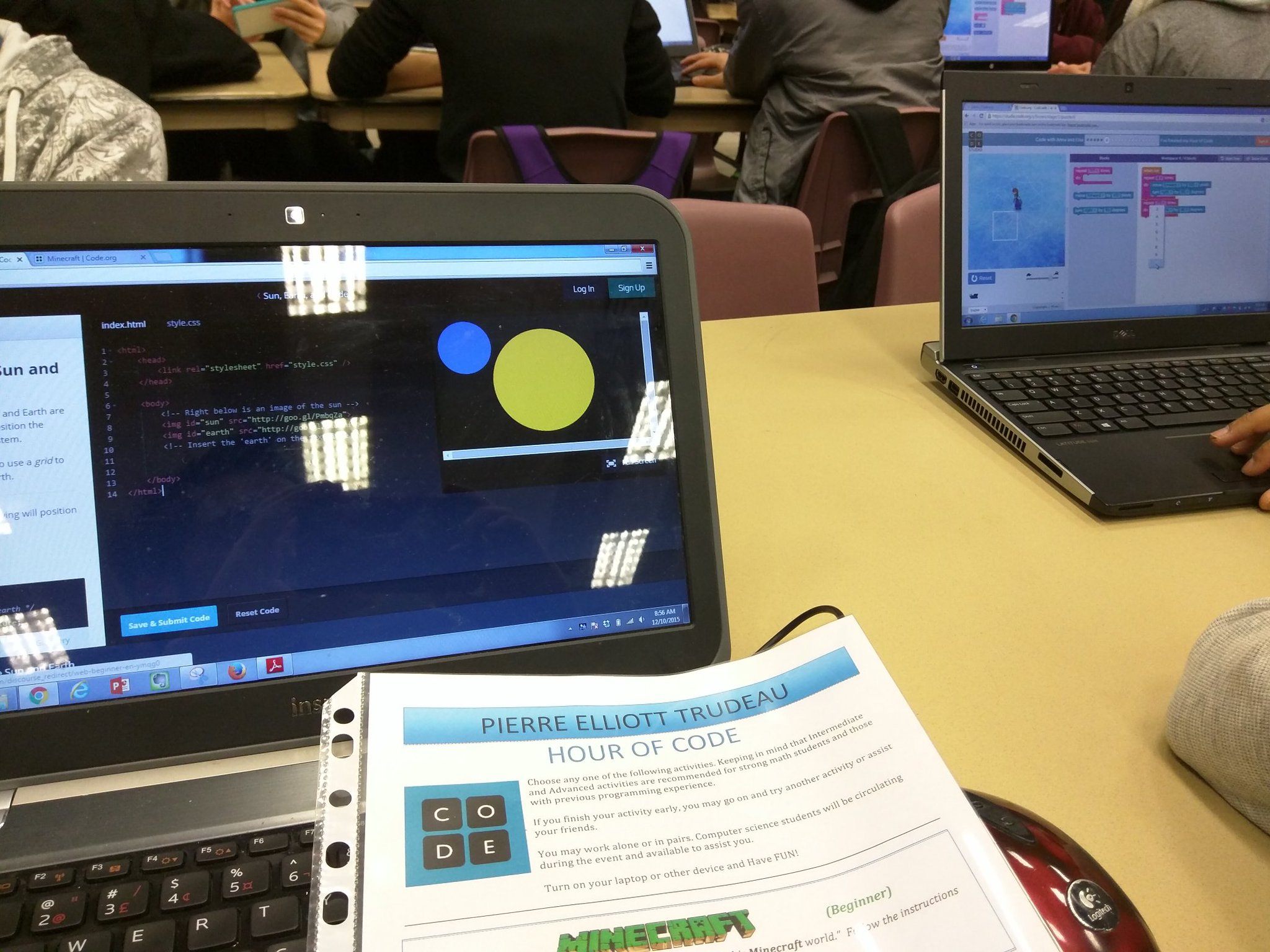
So last week was the Hour of Code.  Our wondrous computer science teachers have decided to involve all the grade 9s and organized a tremendous time in the cafeteria involving 500 students.  I had quite the fun myself as I tackled some good old HTML coding as well as some Star Wars programming.    


I heard from a few of my 9 academic students that they've done this before, but they got a lot more out of this session than in previous years.  They don't realize that maybe perhaps last year's experience set up today's success.  

I wanted to integrate programming into the course.  So I assigned some homework:  

For homework the night before, I had given each student a different set of four numbers.  With each of their four numbers, they were required to create their own 1 step, 2 step, and 2 step equations involving distributive property.

I then introduced my scratch assignment to my 9 applied math class using the previous week's Hour of Code as a springboard.  Students are to make a multiple choice quiz on Scratch with the four questions they did as homework the night before.  I had them start off with a template.  

Some had a little hard time with this because 1) I didn't give them that much time to play with it (one official period only...and 2 other mini periods where they had a choice to study or do this assignment)  and 2) it was introduced in the last week of before holidays when a few other assignments from other classes were due and 3) their reception for learning something completely new wasn't quite in this last week.  

About a third of my class got it done perfectly.  Take a look at this example.    


Others don't know to check and debug.  I know she can solve equations and build equations as I've assessed her separately on a previous test means that she hasn't debugged program properly:  


Here's one student who went above and beyond by using the 30 minutes of introduction and probably previous programming experience to add some bells and whistles to the template I introduced to them:  

There are some that have yet to hand it in.  

I'm going to have to do some work after the break;  I'll probably introduce some peer assessment process to help them go through the debugging process and then help the other 30% that didn't hand it in a little push.   Should I add it to the rubric?  Next semester.

I gave them a template, and they had to follow the instructions.  It was mostly an exercise in creating their own equation, and then a matter of some data entry.  However, the program's template isn't that intuitive, so inevitably, they have to learn the process of debugging and trying again.  They experienced the confusion and pain associated with "programming" - and if they persisted, the joy of "programming" in a microcosm of one period.  


I guess I can give myself a point for integrate programming into the math curriculum without having it take up more time than necessary.  At the same time, it can be argued that they learned more about data entry than programming.  I'll live with that - I've rarely been able to cover the curriculum well in an applied environment and to be able to do something new like this is quite a luxury - especially with the EQAO test next month.  

Alternative assessment of the year?  Done.  Will I try it next semester?  Let's see what my colleague says.

Anyways, here's the rubric (also attached) that I used:    

https://drive.google.com/open?id=0BxWy_f8Du24JSDJkUVJqZTg1ZGs

Thursday, 10 December 2015

A Student Teacher, Teaching the Teacher

A Lesson on Felicia

I have ALMOST given the full reins to my student teacher lately every Thursday when she comes to volunteer. 

I use the word ‘almost’ because a student teacher never truly has their classroom management tested as they’re walking into a classroom with established norms and systems in place that hopefully protect supply/student teachers. 

I’m also in the room while she teaches, which affects the management of the classroom.  

On a separate note, for the first time in eight years, I can say that my applied classroom norms extend strongly even when I have a supply teacher (given the comments they leave behind).  That’s how receptive my students are this year. 

That just means that next year, my students will be wild and out of control, doesn’t it?

On the other hand, my student teacher is incredibly talented and is in her final year of teachers’ college.  I have learnt much from her style, approach and her creativity; case in point, take a look at her lesson on Felicia that she made up:

The question, I could see, resonated with the girls in my classroom.  I guess after questions involving video games, Usain bolt, etc. this was something new. 

My student teacher and I coordinated through my spiral curriculum well as the question was just a touch out of their comfort zone as they just finished learning solving equations and we’ve been through perimeter and area about two times before in previous spirals. 

The question was challenging as they got into groups of two or their ‘rate of change’ partners.  This question demanded the large whiteboards.   


For some reason, the students have been naturally lately looking to group their pairs into group of 4s and 6s.  I immediately broke up the group of 6 as I know that group was just too large.  I let the group of 4 stay as I knew that particular group of 4 worked well.  I still, prefer pairs, so I'll probably split them up next time.  
However, I wanted to see how well they worked and learnt; the next day, I went over it briefly and summarized positives and negatives of each group in terms of their process work, communication, without stating the answer. 

To truly assess how well they worked, I put up the question again.  Now, usually I am not a fan of re-doing a question, or re-assessing the same question, giving multiple opportunities, and doing it in groups…but I’ve been reading so many positive reviews of it that I decided to truly try it again.

It actually worked.

For thinking style type questions, putting the students in groups and allowing multiple opportunities created an environment of learning.  The majority of students actually tried it on their own (except the bottom 5% of the class where collaboration occurred immediately..) before starting to compare answers.  Upon finding differences, these students went through learning conversations where they justified each other’s work. 

For a question that we did yesterday and that I took up earlier, it took almost 20 minutes to get it done.  Some students didn’t even finish.  I guarantee you, as I walked around the classroom listening to their conversations, none of them were fooling around. 

Mind you, I still hesitate at the thought of doing summative thinking questions in groups with my academic students because I know the ‘Mr. Shin caught your mistake’ current environment I’ve set up would cause more of my students to copy off other students as opposed to learning it. 

I am really going to have to rethink my teaching as I found that those rich discussions that the students had with each other is worth designing the curriculum for.    

What’s hilarious is that the education world made this discovery about math education about 5 years ago when Dan Meyer first landed in a TedX talk.  Education has already moved on from this to the next phase – but at this point, the latest stuff is too progressive and far left reaching for me. I've never been an innovator; I've always been a late adopter myself to make sure the 'latest' trend actually sticks around and works with the common teacher.

Maybe if I was an elementary school teacher, I would make the jump ASAP to the latest educational trend; but as a secondary school teacher where post secondary institutions require a certain level of standardized skill, I don’t think I could ever make that jump.  

Maybe in another 5 years I’ll make the switch if it has proven to be more than the latest trend.

Things just move so fast. 


Anyways, I’d like to take this opportunity to thank my student teacher for using her beautiful question as a springboard into student learning as well as mine.  

Monday, 7 December 2015

Success! Students Create, Solve, and Assess Equations all on Their Own

I just marked the students' test on spiral #9 which included a) volume of pyramids and b) solving equations.

Volumes of Pyramids
16/22 members of this applied math class achieved level 4 or higher on this multi-step pyramid that involved using the pythagorean theorem first.  Since this is the third time spiraling through pythagorean theorem, this high success rate is not surprising.


Solving Equations
Regarding the solving of equations - take a look at what they produced on the test:


Needless to say, they aced the other questions where they had to solve my equations.  However, their formal LS and RS checks needed a little work, and during their reassessment next week, they hope to capture that portion of the test. 

It shows that the formative peer work they did the day before worked.  I didn't have to do any marking to provide the feedback that they needed.  This community that the students have created in the past 3 months have allowed them to embrace their mistakes.  The amount of learning was exponential as the students were making their own questions on their whiteboards and discussing with each other their own individual problems.  They found each others' mistakes and they would justify to each other why it was a mistake.

Some students thought that a decimal/fraction answer was a "mistake"; they went back and "corrected" the question that they created so that the solution was an integer.  The process of critical thinking necessary to justify and correct it was fun to watch; however, I have put in a mental note for the students' need that a real number (non-integer) is a number too.

I'm glad that none of my students have stated any racist or sexist or any other inappropriate comments; but they certainly are 'fractionists'.  I have to figure out a way to expand their thinking on this one.  

The whiteboards' non permanent surface is a boon for students as there is no eraser mark, white-out, or need for an official eraser.  It encourages students to just write out their thoughts, display their thinking, and promote discussion. 
 
I wish I had employed the spiral curriculum since my first year of teaching with these applied students, as this success rate has been absolutely unbelievable.

At the same time, I have a couple factors that are exaggerating the spiral curriculum's success:

1.  I have motivated kids.  My level of engagement is even higher than that of my academic classes.  Dan Meyer's 3 act math had something to do with that.

2.  I have students with extremely strong learning skills this year.  My classroom management micromanaging at the beginning has paid off continual dividends that the students reap every day.