Showing posts with label evaluation. Show all posts

Saturday, 22 October 2016

Grade 9 math - Part Deux - Improving Retention through Spiraling and Descriptive Feedback

Every year I complain to myself quietly about two things:  1)  lack of retention and 2) kids at this school only care about marks, and not about learning.

Yes, yes, I know - at least they care about something.  I am lucky to be at a school where they care about school, whether it's extrinsically about marks or intrinsically about learning.

However, these are two problems that I would like to solve.

Retention

Quite often, what I taught in September was entirely forgotten about by the time January came; I saw this in some of my 9 academic/11 university-preparation students who did their homework everyday.  For 9 applied students who are less likely to do their homework, retention would become a bigger  issue in my class.  I looked around online and found that some people were also trying to solve the problem of lack of retention through designing the curriculum in a spiral.  Unlike the linear curriculum that I still prefer to implement for my academic/university prep students (maybe it will change), this style of curriculum allows my applied students to see math concepts a couple times repeated throughout the semester, sometimes in a different light  or through a different problem.  The hope was that by seeing the concepts repeated tweaked in a slightly different way after a few times with weeks separated in between, retention would increase.

Learning vs Attaining Marks

This year, while I am still spiraling, it led to the use of descriptive feedback only.  I had a discussion a couple of years ago with a colleague at Trudeau about a situation where if a student scored better on their exam than their term mark, I should consider making their final mark their exam mark.  Their argument was that if a student can demonstrate their learning by the end of the course, it doesn't matter that they couldn't do it in September.  I still am not fully convinced, as I believe that throughout the term there are other pieces like "thinking" or "communication" which are more fairly evaluated when there is more time than a 1.5 hour exam.  However, the colleague still had a key point that I could not shake off - the learning cycle ends with an exam and if students can demonstrate their knowledge and understanding by that time, that should be all that matters.   

Quite often when my students receive a their test, they always look at the mark first before any descriptive feedback.  While the majority of my students react to the actual mark first, there are fewer students that can get past that initial reaction to read the descriptive feedback and actually learn. This makes sense for a student because the test is a natural end and judgement to the learning cycle of a unit or a spiral.

So, I decided to try descriptive feedback only for the first half of the semester to extend the learning cycle.  This emphasizes to them that the first 1 or 2 spirals through the curriculum would be about learning only.  As a result, the principal and the superintendent have given me permission to give "I" as opposed to any marks on the report card for my students for both the interim and midterm report cards.  This has given its own sets of problems as my students really want to know how they're doing in terms of a mark.  I am trying to emphasize to them that learning as much as you can is all that you should be worried about at this time.

I just want to leave you with this final quote from my student.  The context was this - it was September when I was having trouble convincing my own students that there wouldn't be any marks.  There was a general consensus among the twenty of them that they would actually want marks just to know where they are.  I was about to lose them when one of my students said: "I get it now...school becomes more about learning than it is about passing."  All the students had an 'aha' moment given to them from another student.  It was one of the more impressive 'aha' moments I have witnessed in my 10 year career...and I wasn't the source of it.  What's more interesting, is that this 'aha' moment was more rewarding than any other.  


Sunday, 24 January 2016

Character Education - Honesty with Marks

One of the things that I wonder about as a teacher is the relationship between marks and learning. While this debate can run quite deep with some teachers advocating to do-away with marks entirely and others on the opposing spectrum to anything in between.

 I am going to look at this from the student's perspective.  Especially when it comes to grade 12, many students focus solely on mark grabbing and hopefully learning occurs along the way.  I try to emphasize that if students focus on learning as the priority, then the marks will naturally come.

It's just easier, from the student's point of view, to focus on getting marks first which promotes behaviours that I don't consider 'true learning' such as passing around last year's tests, studying at the last second for the short term memory thing, cheating, and memorizing.    

Some will say it's the teachers' fault for setting up this system.  Others' will fault the universities' inability to sort through candidates other than through marks.  It might be a little from column A and a little from column B, and even from an unknown C that I haven't quite considered. 

The beauty of being a teacher is that in many ways, I control the classroom.  In my little world here, I can highlight and contrast the difference between a mark grabbing student and a student that learns for my own students.  

Every year, at the beginning, my students write a diagnostic that does not count for marks.  When I mark it the multiple choice portion, I purposely:

1)  take away a mark that they deserve 
2)  give them an extra mark that they do not deserve

In the end, their mark stays the same.  However, after I take it up the test and show the marking scheme, I go around individually to each student asking how I should change their mark.

I have found in the two years  that I have done this, many students state that their mark goes up by 1, a few ask to bring down their mark by 1, and many so no change.

I then ask the students to reflect on their action.  I cannot judge what they did because I do not know the rationale behind their action but I take the time to highlight the following:

A)  If you asked me to reduce your mark knowing full well you deserve another mark, then you are too hard on yourself.  You deserve another mark, and should ask for it - after all, you got the answer right as well as another question wrong.

B)  If you asked me to increase your mark by 1 or decrease your mark by 1 because you didn't notice the other mistake I made, then you have to pay attention a little more during test takeup.  This is a time to learn from your mistakes, which is quite often the best time to learn.  Be a little more detail oriented and listen carefully for these are important skills in life. 

C)  If you said "no change" because you didn't notice anything wrong, then you are not paying attention whatsoever.  (I may run the risk of an IEP student that has issues with the delivery, but I do make sure to show the multiple choice answers visually and say the answers aloud for each question so that should cover most minor IEPs.)

D)  A few students say "no change" but have already done their self-reflection on what question was actually right and what question was wrong.  This is fine as well.

E)  Each class, there's always one or two students that tell me explicitly that I marked one question right and one question wrong, showing true transparency to me.  This is awesome, and it is something I tell them I try to do for them as a teacher.

F)  This is the last option I go over.  I've learnt to explain this last option gently as a few of my more sensitive students feel guilty even when they didn't do this.  If a student asks for a +1 in marks knowing full well they should have a no mark change, then I ask these students that find themselves in this position to do some deep reflection.  I state: "You have just lied to me about your mark.  What did I do to you in the last week to deserve this?  (hopefully I did nothing wrong in the past week to start the school year off).  You have just inflated your mark to your parents about your mark.  Above all, you're willing to lie to yourself and pat yourself on the back for getting a higher mark than you deserve.  If you're willing to lie to yourself to inflate your mark, lie to me who has done nothing to you, and even your parents on a diagnostic test that doesn't even count for marks - what are you going to do when it comes to money or other situations?

This year, I delivered my speech well.  I returned a test on January 4th, and made a mistake on a multiple choice question.  This is almost 4 months after my little stunt.

Class 1:  I had 7 students come to for a mark increase. I had 8 students come to me for a 1 mark decrease.

Class 2:  I had 8 students come for a mark increase and 7 marks come for a mark decrease. 

As you can see, grade 9s are very receptive to this sort of thing.

When I pull this stunt with my grade 12s, I get into deep debates with my grade 12 students when I ask them these questions.  The one thing they always bring up is that this mark is so small, it doesn't matter.  From their perspective, this if this one mark occurred on a summative assessment, it would help them in their goal to getting into university and it doesn't hurt anyone.  If it doesn't hurt anyone, why not do it?

We then go back and forth about the fact that if you increase your marks unfairly to get into a university program, you're kicking someone else out of the same university program.


I know deep down that the system will have to change to have any permanent effects, but in the end, it's a fun debate and a good exploration on what honesty really means.  I learn much of my students in this little experiment and I'll probably continue to do it. 

Tuesday, 15 December 2015

Capitalizing on the Hour of Code: An Alternative Assessment for Solving Equations

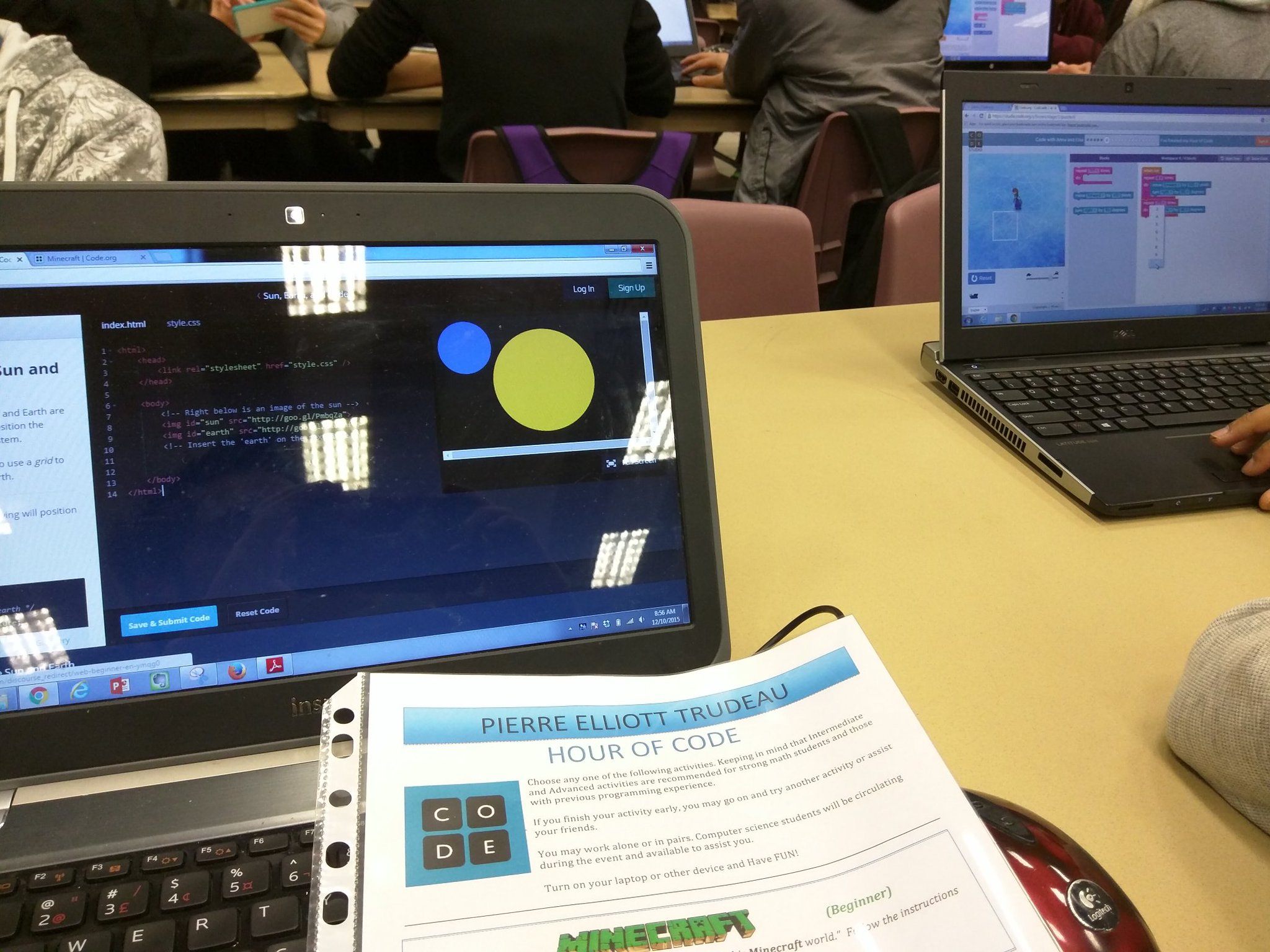
So last week was the Hour of Code.  Our wondrous computer science teachers have decided to involve all the grade 9s and organized a tremendous time in the cafeteria involving 500 students.  I had quite the fun myself as I tackled some good old HTML coding as well as some Star Wars programming.    


I heard from a few of my 9 academic students that they've done this before, but they got a lot more out of this session than in previous years.  They don't realize that maybe perhaps last year's experience set up today's success.  

I wanted to integrate programming into the course.  So I assigned some homework:  

For homework the night before, I had given each student a different set of four numbers.  With each of their four numbers, they were required to create their own 1 step, 2 step, and 2 step equations involving distributive property.

I then introduced my scratch assignment to my 9 applied math class using the previous week's Hour of Code as a springboard.  Students are to make a multiple choice quiz on Scratch with the four questions they did as homework the night before.  I had them start off with a template.  

Some had a little hard time with this because 1) I didn't give them that much time to play with it (one official period only...and 2 other mini periods where they had a choice to study or do this assignment)  and 2) it was introduced in the last week of before holidays when a few other assignments from other classes were due and 3) their reception for learning something completely new wasn't quite in this last week.  

About a third of my class got it done perfectly.  Take a look at this example.    


Others don't know to check and debug.  I know she can solve equations and build equations as I've assessed her separately on a previous test means that she hasn't debugged program properly:  


Here's one student who went above and beyond by using the 30 minutes of introduction and probably previous programming experience to add some bells and whistles to the template I introduced to them:  

There are some that have yet to hand it in.  

I'm going to have to do some work after the break;  I'll probably introduce some peer assessment process to help them go through the debugging process and then help the other 30% that didn't hand it in a little push.   Should I add it to the rubric?  Next semester.

I gave them a template, and they had to follow the instructions.  It was mostly an exercise in creating their own equation, and then a matter of some data entry.  However, the program's template isn't that intuitive, so inevitably, they have to learn the process of debugging and trying again.  They experienced the confusion and pain associated with "programming" - and if they persisted, the joy of "programming" in a microcosm of one period.  


I guess I can give myself a point for integrate programming into the math curriculum without having it take up more time than necessary.  At the same time, it can be argued that they learned more about data entry than programming.  I'll live with that - I've rarely been able to cover the curriculum well in an applied environment and to be able to do something new like this is quite a luxury - especially with the EQAO test next month.  

Alternative assessment of the year?  Done.  Will I try it next semester?  Let's see what my colleague says.

Anyways, here's the rubric (also attached) that I used:    

https://drive.google.com/open?id=0BxWy_f8Du24JSDJkUVJqZTg1ZGs

Thursday, 10 December 2015

A Student Teacher, Teaching the Teacher

A Lesson on Felicia

I have ALMOST given the full reins to my student teacher lately every Thursday when she comes to volunteer. 

I use the word ‘almost’ because a student teacher never truly has their classroom management tested as they’re walking into a classroom with established norms and systems in place that hopefully protect supply/student teachers. 

I’m also in the room while she teaches, which affects the management of the classroom.  

On a separate note, for the first time in eight years, I can say that my applied classroom norms extend strongly even when I have a supply teacher (given the comments they leave behind).  That’s how receptive my students are this year. 

That just means that next year, my students will be wild and out of control, doesn’t it?

On the other hand, my student teacher is incredibly talented and is in her final year of teachers’ college.  I have learnt much from her style, approach and her creativity; case in point, take a look at her lesson on Felicia that she made up:

The question, I could see, resonated with the girls in my classroom.  I guess after questions involving video games, Usain bolt, etc. this was something new. 

My student teacher and I coordinated through my spiral curriculum well as the question was just a touch out of their comfort zone as they just finished learning solving equations and we’ve been through perimeter and area about two times before in previous spirals. 

The question was challenging as they got into groups of two or their ‘rate of change’ partners.  This question demanded the large whiteboards.   


For some reason, the students have been naturally lately looking to group their pairs into group of 4s and 6s.  I immediately broke up the group of 6 as I know that group was just too large.  I let the group of 4 stay as I knew that particular group of 4 worked well.  I still, prefer pairs, so I'll probably split them up next time.  

However, I wanted to see how well they worked and learnt; the next day, I went over it briefly and summarized positives and negatives of each group in terms of their process work, communication, without stating the answer. 

To truly assess how well they worked, I put up the question again.  Now, usually I am not a fan of re-doing a question, or re-assessing the same question, giving multiple opportunities, and doing it in groups…but I’ve been reading so many positive reviews of it that I decided to truly try it again.

It actually worked.

For thinking style type questions, putting the students in groups and allowing multiple opportunities created an environment of learning.  The majority of students actually tried it on their own (except the bottom 5% of the class where collaboration occurred immediately..) before starting to compare answers.  Upon finding differences, these students went through learning conversations where they justified each other’s work. 

For a question that we did yesterday and that I took up earlier, it took almost 20 minutes to get it done.  Some students didn’t even finish.  I guarantee you, as I walked around the classroom listening to their conversations, none of them were fooling around. 

Mind you, I still hesitate at the thought of doing summative thinking questions in groups with my academic students because I know the ‘Mr. Shin caught your mistake’ current environment I’ve set up would cause more of my students to copy off other students as opposed to learning it. 

I am really going to have to rethink my teaching as I found that those rich discussions that the students had with each other is worth designing the curriculum for.    

What’s hilarious is that the education world made this discovery about math education about 5 years ago when Dan Meyer first landed in a TedX talk.  Education has already moved on from this to the next phase – but at this point, the latest stuff is too progressive and far left reaching for me. I've never been an innovator; I've always been a late adopter myself to make sure the 'latest' trend actually sticks around and works with the common teacher.

Maybe if I was an elementary school teacher, I would make the jump ASAP to the latest educational trend; but as a secondary school teacher where post secondary institutions require a certain level of standardized skill, I don’t think I could ever make that jump.  

Maybe in another 5 years I’ll make the switch if it has proven to be more than the latest trend.

Things just move so fast. 


Anyways, I’d like to take this opportunity to thank my student teacher for using her beautiful question as a springboard into student learning as well as mine.