Showing posts with label assessment. Show all posts

Saturday, 18 June 2016

Pear Deck Experiment - Final Thoughts

As I wrap up the semester, it's time for that reflection to see what went right and what went wrong.  This year, I decided to try a Pear Deck experiment.  I felt it would have the audience interact with me and also make use of the technology that my students seemed to have.

It was silly, but I first tried it out in my first ever presentation in front of teachers at the YRDSB QUEST conference.  Looking back at it now, I was quite a beginner and it wasn't the greatest place to try and fail at it as you can see the audience was made up of many big-wigs in the board and around the world.  Oh well, you live and you learn.

I learnt my lesson, and practiced Pear Deck more in the classroom where the audience was a little more forgiving.  It also modeled for my students the importance of trying something new.  Not being afraid to fail.  After a few lessons, I got the basics down.  As with anything new, a teacher has to let them play with the technology first before getting to the real learning that can come with the technology:


The students nowadays seem to be interested in the illuminati, it seems.

After a few trials with my students, I had the confidence to try it again during my 3rd presentation of the year at OAME (Ontario Association for Mathematics Education).


/script>
Given the feedback I got from this workshop session I ran, it looks like my Pear Deck experiment was a success 8 months later.  There will be more on my OAME session later in a different post.

Moving forward, to make use of this technology properly, I have to get my pedagogy up to par.  Asking great questions is an extremely important skill as a teacher.  This technology can amplify the effect of a good question or bad question.  I saw that when I made deep, interesting questions, the Pear deck amalgamated all of the students' answers and we could have a discussion based off it.   It allowed my introverted students to participate without having to speak aloud in class.   However, if I made too simple of a question, the students would either not bother to answer or start to graffiti the slide.

When I ask a question, I have to be able to identify if we want to discuss it verbally or if it's a deeper question, I can let Pear Deck do its thing.

When trying to guide, discuss, push, prod - it's important to step away from the projector and to discuss with the class.

When it's time to let the students think - Pear Deck gives the students the space and time to think and illustrate their answer.

I'd like to practice using it next year, but I think I'd have to ask the administration for it, as it is super expensive.  Perhaps I'll try a similar software in Nearpod, next year.  

In the end, however, I had fun trying something new and the experience has made me a better teacher - which is all I can ask for.

Sunday, 24 January 2016

Character Education - Honesty with Marks

One of the things that I wonder about as a teacher is the relationship between marks and learning. While this debate can run quite deep with some teachers advocating to do-away with marks entirely and others on the opposing spectrum to anything in between.

 I am going to look at this from the student's perspective.  Especially when it comes to grade 12, many students focus solely on mark grabbing and hopefully learning occurs along the way.  I try to emphasize that if students focus on learning as the priority, then the marks will naturally come.

It's just easier, from the student's point of view, to focus on getting marks first which promotes behaviours that I don't consider 'true learning' such as passing around last year's tests, studying at the last second for the short term memory thing, cheating, and memorizing.    

Some will say it's the teachers' fault for setting up this system.  Others' will fault the universities' inability to sort through candidates other than through marks.  It might be a little from column A and a little from column B, and even from an unknown C that I haven't quite considered. 

The beauty of being a teacher is that in many ways, I control the classroom.  In my little world here, I can highlight and contrast the difference between a mark grabbing student and a student that learns for my own students.  

Every year, at the beginning, my students write a diagnostic that does not count for marks.  When I mark it the multiple choice portion, I purposely:

1)  take away a mark that they deserve 
2)  give them an extra mark that they do not deserve

In the end, their mark stays the same.  However, after I take it up the test and show the marking scheme, I go around individually to each student asking how I should change their mark.

I have found in the two years  that I have done this, many students state that their mark goes up by 1, a few ask to bring down their mark by 1, and many so no change.

I then ask the students to reflect on their action.  I cannot judge what they did because I do not know the rationale behind their action but I take the time to highlight the following:

A)  If you asked me to reduce your mark knowing full well you deserve another mark, then you are too hard on yourself.  You deserve another mark, and should ask for it - after all, you got the answer right as well as another question wrong.

B)  If you asked me to increase your mark by 1 or decrease your mark by 1 because you didn't notice the other mistake I made, then you have to pay attention a little more during test takeup.  This is a time to learn from your mistakes, which is quite often the best time to learn.  Be a little more detail oriented and listen carefully for these are important skills in life. 

C)  If you said "no change" because you didn't notice anything wrong, then you are not paying attention whatsoever.  (I may run the risk of an IEP student that has issues with the delivery, but I do make sure to show the multiple choice answers visually and say the answers aloud for each question so that should cover most minor IEPs.)

D)  A few students say "no change" but have already done their self-reflection on what question was actually right and what question was wrong.  This is fine as well.

E)  Each class, there's always one or two students that tell me explicitly that I marked one question right and one question wrong, showing true transparency to me.  This is awesome, and it is something I tell them I try to do for them as a teacher.

F)  This is the last option I go over.  I've learnt to explain this last option gently as a few of my more sensitive students feel guilty even when they didn't do this.  If a student asks for a +1 in marks knowing full well they should have a no mark change, then I ask these students that find themselves in this position to do some deep reflection.  I state: "You have just lied to me about your mark.  What did I do to you in the last week to deserve this?  (hopefully I did nothing wrong in the past week to start the school year off).  You have just inflated your mark to your parents about your mark.  Above all, you're willing to lie to yourself and pat yourself on the back for getting a higher mark than you deserve.  If you're willing to lie to yourself to inflate your mark, lie to me who has done nothing to you, and even your parents on a diagnostic test that doesn't even count for marks - what are you going to do when it comes to money or other situations?

This year, I delivered my speech well.  I returned a test on January 4th, and made a mistake on a multiple choice question.  This is almost 4 months after my little stunt.

Class 1:  I had 7 students come to for a mark increase. I had 8 students come to me for a 1 mark decrease.

Class 2:  I had 8 students come for a mark increase and 7 marks come for a mark decrease. 

As you can see, grade 9s are very receptive to this sort of thing.

When I pull this stunt with my grade 12s, I get into deep debates with my grade 12 students when I ask them these questions.  The one thing they always bring up is that this mark is so small, it doesn't matter.  From their perspective, this if this one mark occurred on a summative assessment, it would help them in their goal to getting into university and it doesn't hurt anyone.  If it doesn't hurt anyone, why not do it?

We then go back and forth about the fact that if you increase your marks unfairly to get into a university program, you're kicking someone else out of the same university program.


I know deep down that the system will have to change to have any permanent effects, but in the end, it's a fun debate and a good exploration on what honesty really means.  I learn much of my students in this little experiment and I'll probably continue to do it. 

Tuesday, 15 December 2015

Capitalizing on the Hour of Code: An Alternative Assessment for Solving Equations

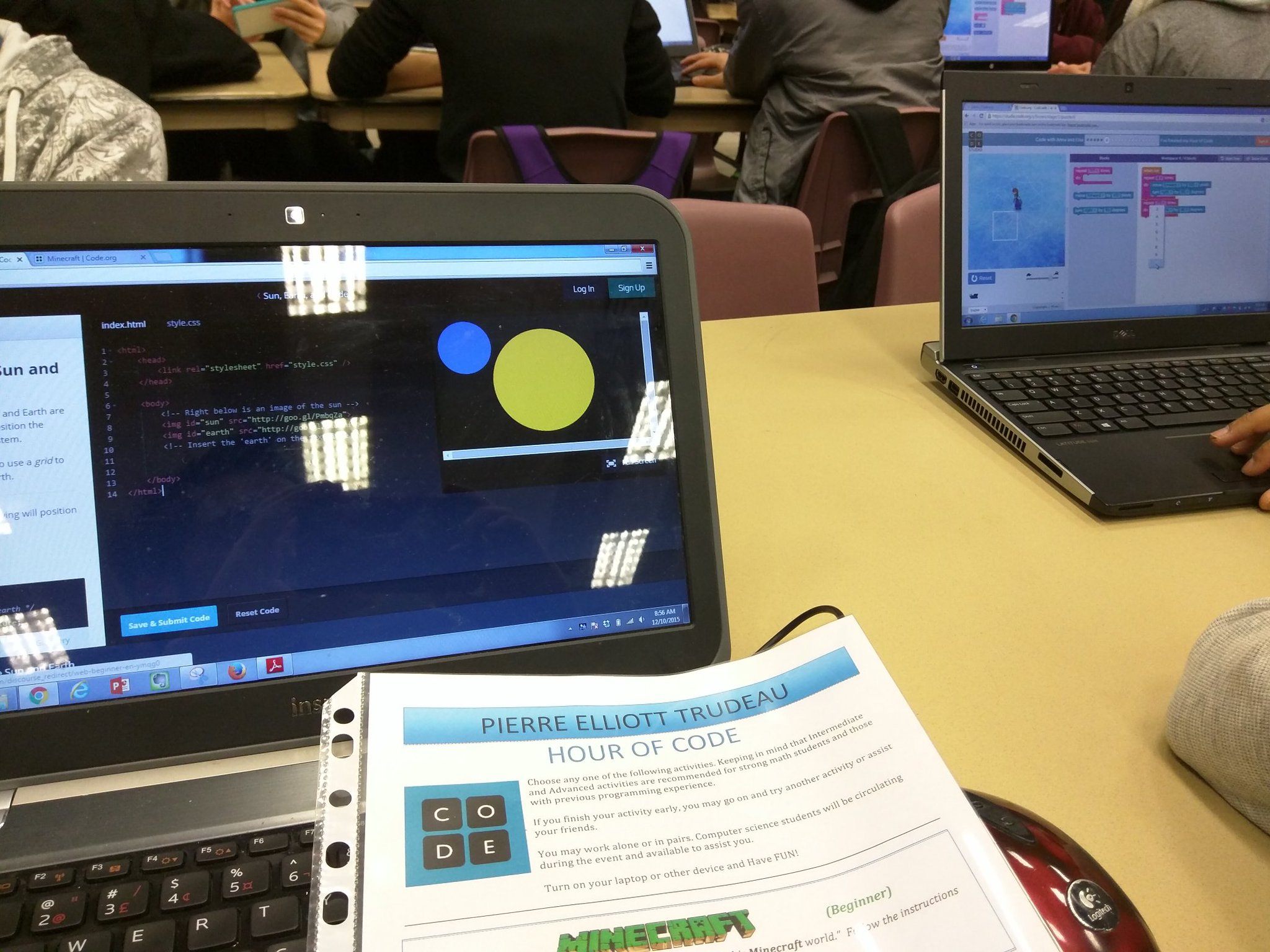
So last week was the Hour of Code.  Our wondrous computer science teachers have decided to involve all the grade 9s and organized a tremendous time in the cafeteria involving 500 students.  I had quite the fun myself as I tackled some good old HTML coding as well as some Star Wars programming.    


I heard from a few of my 9 academic students that they've done this before, but they got a lot more out of this session than in previous years.  They don't realize that maybe perhaps last year's experience set up today's success.  

I wanted to integrate programming into the course.  So I assigned some homework:  

For homework the night before, I had given each student a different set of four numbers.  With each of their four numbers, they were required to create their own 1 step, 2 step, and 2 step equations involving distributive property.

I then introduced my scratch assignment to my 9 applied math class using the previous week's Hour of Code as a springboard.  Students are to make a multiple choice quiz on Scratch with the four questions they did as homework the night before.  I had them start off with a template.  

Some had a little hard time with this because 1) I didn't give them that much time to play with it (one official period only...and 2 other mini periods where they had a choice to study or do this assignment)  and 2) it was introduced in the last week of before holidays when a few other assignments from other classes were due and 3) their reception for learning something completely new wasn't quite in this last week.  

About a third of my class got it done perfectly.  Take a look at this example.    


Others don't know to check and debug.  I know she can solve equations and build equations as I've assessed her separately on a previous test means that she hasn't debugged program properly:  


Here's one student who went above and beyond by using the 30 minutes of introduction and probably previous programming experience to add some bells and whistles to the template I introduced to them:  

There are some that have yet to hand it in.  

I'm going to have to do some work after the break;  I'll probably introduce some peer assessment process to help them go through the debugging process and then help the other 30% that didn't hand it in a little push.   Should I add it to the rubric?  Next semester.

I gave them a template, and they had to follow the instructions.  It was mostly an exercise in creating their own equation, and then a matter of some data entry.  However, the program's template isn't that intuitive, so inevitably, they have to learn the process of debugging and trying again.  They experienced the confusion and pain associated with "programming" - and if they persisted, the joy of "programming" in a microcosm of one period.  


I guess I can give myself a point for integrate programming into the math curriculum without having it take up more time than necessary.  At the same time, it can be argued that they learned more about data entry than programming.  I'll live with that - I've rarely been able to cover the curriculum well in an applied environment and to be able to do something new like this is quite a luxury - especially with the EQAO test next month.  

Alternative assessment of the year?  Done.  Will I try it next semester?  Let's see what my colleague says.

Anyways, here's the rubric (also attached) that I used:    

https://drive.google.com/open?id=0BxWy_f8Du24JSDJkUVJqZTg1ZGs