Monday, 5 September 2016


I was so pumped after my 3rd teacher workshop of the year that I had to take a picture. 


Earlier this year I did my first math workshop.  Here was the description: 

Are your academic & applied grade 9s disengaged? Learn how other teachers and I transformed our teaching practice utilizing the spiral curriculum to increase retention of math. By using a combination of Dan Meyer's problem-based 3-act math, collaborative white-boarding, and Knowledge Hook's online technology, students are more engaged and rediscover an enjoyment of math. Come and learn how to efficiently implement one or any of these strategies to jump start your classes' retention and engagement! 

I checked quite often (even though I know it was unhealthy to) to see how many people were attracted to my description. It was crushing.  Even on the last day leading up to OAME, there were 3 people who signed up for my session. I managed to console myself by stating that it will be easy and having fewer people is  a good way to start one's first math workshop.  I also managed to convince myself that because it was on a Friday and it was the last session of the day...most people wouldn't come anyway.  So I managed to not take it personally.

Boy was I wrong about the number of people.  I had 30+ show up to my session!  Well, this OAME “Endlessly Spiralling  through Grade 9 Math” was much better than my previous two presentations on “To Blog , where No Blog has Gone Before”. 

There are a couple comparisons that are important to note here:
·         
  • After two workshop presentations, I think I got the hang of it.  I went from a 1-way presenter of  disseminating information to an interactive teacher/facilitator that talked and listened to the audience.  I sometimes would lead a discussion with the audience but also lean on the experience of the audience as well for input or further expertise.  
  • I’ve been using blogging as a tool in the classroom for over a year whereas I’ve been spiraling for only 9 months.  However, I am much more comfortable talking about spiraling in math than I am about the use of blogging in the classroom. 
  • I used Pear Deck many times in the classroom before I did my math presentation vs my blogging presentation. 

Here is some feedback on my presentation.  Looks like about 7 people answered this first question, even though over 20+ attended.  Not everyone fills out feedback forms:    

Leading a discussion with fellow educators and administrators requires a very different than I had developed teaching teenagers. One of the biggest difference I learnt was that there was a curriculum when teaching the students versus no curriculum when at a workshop.  At a workshop, the content discussed better be useful for the audience or else it’s a failure.  In the classroom, the content discussed often isn’t the teacher or student’s choice, so we just have to make the best of it.  As a result, I started my presentation using Pear Deck to interact with the audience.  I used to only use it to get to know where everyone is from, which age group they most affect etc….

This time I used it to ask what they expected out of the workshop.  It became evident as I was browsing through their comments that some of my expectations and their expectations didn’t align.  I went through the list and acknowledged each one of their expectations; I would defer some, promising to get to it later in the presentation, and others I would answer on the spot.   A few questions I wasn’t within the scope of the presentation and I apologized but at the same time used this as a segue to the fact that I wouldn’t get offended if anyone left early.  This portion was informal in nature and opened up the floor quite a bit.  

I spent only 3 hours explicitly preparing for my OAME presentation whereas I spent days preparing for my blogging presentation.  It’s amazing that out of the 7 people that responded, 3 stated that I was ‘somewhat organized’ and 4 stated that I was ‘well-organized’.  However, upon reflection, I’ve actually spent a lot more time preparing for this presentation than the 3 hours beforehand. 

When I went to George Couros’s presentation back in October, he stated that he formatively spent 5 years writing on a blog getting feedback from all sorts of people around the world.  He would get his ideas refined and learnt how to wordsmith. 

Something similar happened to me here – I blogged about spiraling for 7 months beforehand, and I could whip together a presentation in 3 hours and then speak about it in an organized, confident manner the next day.  Normally I would have much trouble talking about my experiences, but blogging helped me refine my thoughts so that when I spoke, it wasn’t a big jumble.  

Wow.  I was thinking that OAME was hiding negative feedback at first here, because there seems to be only one person answering these questions now.  However, I looked back up and saw that there is still some negative feedback, so maybe? 

Nevertheless, I guess the respondents finished off the survey at the end, which showed I did an ok job:  3 people said it was ok, 3 people said good, and 2 found my session to be great!  I still have to work on things as only one person would recommend me as a speaker – now I have something to work towards.  Looking back – I have to work on my content.  I am not very knowledgeable about the changing math education.  My goal is to read Jo Boaler’s “Mathematical Mindsets” this summer and hopefully I’ll have a better scope and understanding of what her student Dan Meyer was going towards.    

Except….I forgot to apply to run workshops for 2016/2017 year as ultimate took up my entire life from May to June.  You live and you learn I guess.    On to the next year!  Can't wait to start tomorrow!

Thursday, 25 August 2016

Ultimate Frisbee Season Wrapup

It's long over due as it's been 1.5 months since the season finished, but many of the players requested the speeches be placed online.  So here's the overview of the season from my perspective:  

We started with two teams, with both teams posting 0 wins in our first tournament.  ZERO.  0-9-1.  None of you guys let that dissuade you from practicing and improving.  You put your head down and worked. Every morning we put ourselves to the ultimate grind and became better.  Inch by inch, we clawed our way out of the basement, out of terrible deficits in games, and into the playoffs.  In the end we reached a high level of play and Trudeau finished 3rd in the tier 1 division.  This is no small feat, as ultimate is now the most popular sport in York Region with over 1500 students playing - and for Trudeau to finish 3rd among all teams in the tier 1 division is a testament to all the hard work that you've done.  What's even more impressive is that all of this was done with high levels of sportsmanship, honour, fairness, and incredible spirit throughout the whole season.

Recognition must also be placed on the support system of the team - assistant coaches and managers.


Both assistant coaches came back enriched from their varsity experience at York.  Tim, who would have a hard time going to morning practices, now voluntarily arrived early to give each player many small pointers, giving players the fine details that would all add up to the huge result we got this year.  Justin, came to all practices since school finished and had a hand in designing practices, lineups, and delivering motivational speeches during games.   His observations made in-game as well as the advice given to the players in practice were a huge boon in helping us reach our 3rd place finish.


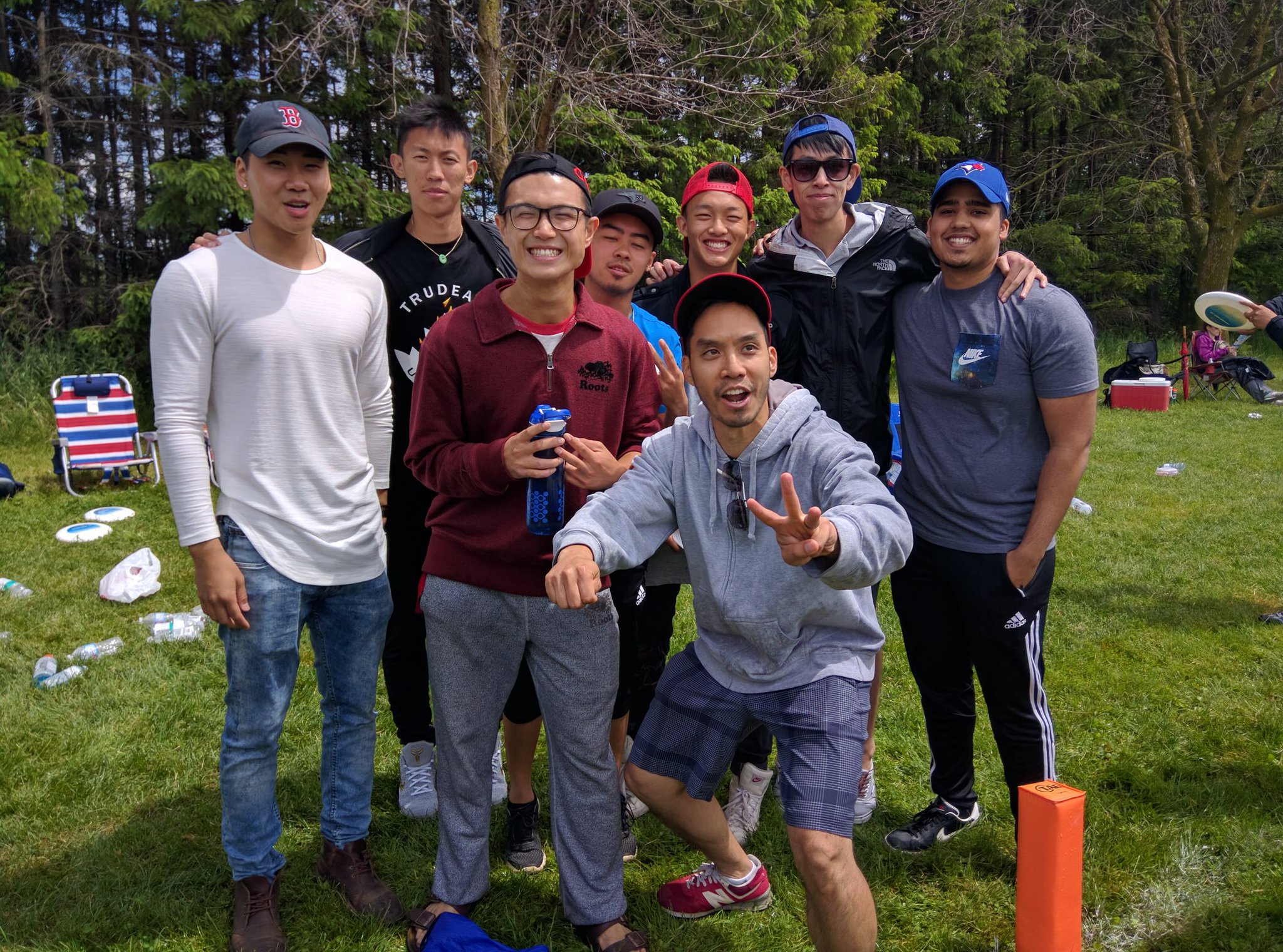
@trudeauhs alumni coming out to help push our team to the highest finish ever in trudeau history! pic.twitter.com/NEwt30Q6JK

— Andrew Shin (@MrAShinYRDSB) June 7, 2016

In the above tweet there are my two assistant coaches Justin and Tim and a bunch of alumni coming to visit in the last tournament. Clockwise from left: Derek Choy (2014), Tim Truong (2015), Adwin Lau, Calvin (2014), Aaron Cheung (2015), Neil Patel (2014), Andrew Shin (myself), and Justin Cheung (2015)


Managers Grace and Kristy collected money, photocopied handouts, collected and checked sheets, made announcements, sent reminders, did attendance, tracked missed shifts, set up the field, separated pinnies, collected discs, organized payments of discs, designed practices, timekeeping, played guitar, sang, scorekeeping, talking with other coaches, booked fields and courts, sat down with Mr. Shin the day before each practice to design practice and know where pylons go, etc.  They made life easier without the second coach for me this year and none of this would have happened without their help.


Graduating members of the team:  From the left:  Doris, Grace (manager), Ivan, Eastelle (not graduating), Nathan, Maggie, and Kristie (manager)

Captains - thanks for handling the ordering of the jerseys and for communicating with the other team regarding spirit scores!  Setting up the last game as a spirit game was a tremendous idea as well and made for a memorable experience.

Others - there are certain days when managers weren't present...and the same people would help pickup pylons and collect discs at the end of each practice.  I appreciate you doing these small things consistently.  I know who you are, and so do you =)


I then had the opportunity to deliver speeches for four individuals in the night.  Here they are:


Female captain and MVP:  Maggie Zhang
Since grade 9, she carefully learnt and practiced the craft of ultimate, mastering the art of the ‘flick’, the backhand, the in-cut, the zone defence.  It wasn’t always rosy, as she often had to learn from the bench and practice only.  Her playing time in the past wasn’t always regular.   She would maybe touch the disc once or sometimes none in a game. 
Fast forward to today and you’ll see at the end of each game the other team offering their respect for her in the form of daps, mvp chants and awards.  Why?  She now touches the disc maybe 5 times in a span of 30 seconds, helping the team march down the field for a score. 
She also does the little, often unseen things for the team;  packing up discs if a manager isn’t present;  talking and trying to include other quieter team members into discussions;  making thoughtful observations during practice to improve things.    
I’ve coached her and watched her grow in the past four years.  To paraphrase a certain Toronto-born rapper, she started from the bottom in grade 9, and now she’s here – at the top – as a captain, helping to push the team to perhaps its best finish in Trudeau history. 
I present to you, the best story of the growth mindset, one who persevered, and never stopped improving - Trudeau’s female ultimate captain  & MVP – Maggie Zhang. 


Male Captain and MVP:  Ivan Yung 
With the opposition watching his flicks as if in a drive-in,
Helping at practices to help his teammates thriven,
Blocking the discs on defence like a bison,
Doing all the hard stuff and willing to just ‘dive-in’,
When our team is down, he hypes the team like a siren,
With a steely determination and perseverance as hard as a diamond,
I present to you Trudeau’s ultimate male captain and MVP – Ivan. 

Female Junior Athlete of the Year:  Talitha Ling
Her other coaches describe her as very skilled and dedicated.  Versatility doesn’t even begin to describe her as on the volleyball court she can spike, block, stuff, set, dig, place, ace, prevent campfires, serve, pancake (but not serve pancakes) – she can do it all.   And once she became the team’s setter, the team started to perform better. She was the glue the varsity girls’ volleyball team needed to succeed.
“An amazing athlete, with coordination and polished footwork” – said one of her coaches. 
And that coordination and footwork translated straight onto the ultimate field as she played her second varsity sport -  ultimate.  As a grade 10 player she quickly mastered the throws, was trusted by her veteran teammates to catch difficult passes as she quickly darted in and out of spaces like a shadow to get the disc and help the team move upfield. 
I present to you Trudeau’s junior female athlete of the year – Talitha Ling. 


Junior Male Athlete of the Year – Jonah Cheung
He can pass and he can go for a kill.  He can cover the baseline or the centre line with a defence that smothers his opponents.  He elevates his play during a pressure situations, on a match point, whether he needs a long or short serve. 
Wait, which sport am I talking about?  Volleyball or badminton?   
Both.  
But it’s not just about those sports.   
In ultimate, he is a swiss army knife when it comes to his assortment of throws that he can pull off.  He breaks through zones with relative ease, utilizing his multiple ultimate skills.  His determination and tenacity is on display as he plays every other shift, taking on the bulk of offensive duties as a handler. 
He is a responsible, intelligent, and athletic individual who is dedicated to his sports and his teams.  Oh and one more thing – he is often found during practice helping others the art of the ‘flick’. 
Which sport am I talking about now? 
Badminton and ultimate. 

I present to you, Trudeau’s helpful, knowledgeable, and  junior male athlete of the year – Jonah Cheung.    


Thursday, 7 July 2016

My Grade 9 Academic Review of Mr. Shin

Every year, I ask my grade 9 academic students to review me, and give me my report card.  For a course that I've done a few times, where I don't think I can get as much out of my own reflection, it is important I at least ask the kids to write something.  Then, it forces me to self-evaluate and reflect on some level.

Here it is!

Mr. Shin should:

Start:
Giving more rewards so we can try for food. Food is life.
Add memes to your presentations.
Teaching us lessons for longer periods of time instead of entrance cards  +1
Do more interactive activities because that helped people learn/remember new information
More inquiry questions
More Knowledge hook
Practicing more application questions
Putting multiple choice on exams (I did?)
More interactive stuff
Projects +1
Start using pictures on the computer and technology more often
Use a ruler(joke) 
Check homework more often  +1+1
Check homework without warning
No option for wall sits or detention (always wall sits!  =)  )
Punish students with math problems instead of wallsits/detention
Ask people where they want to sit
Write bigger on board
EQAO review earlier


Stop:
Try not to make as many mistakes or your legs will be too strong (wall sits)
Making us go outside of class to do activities bc I don't want to move
Using technology and could teach us more lessons
Nothing
Wall sits, try burpee insteads
Stop doing one hour long lessons so we can actually try out the work ourselves
Stop using the whole class time on ecards
Shouting
Making mistakes
Making tests hard

Continue:
Being awesome
Teaching
Explaining Concepts
Being enthusiastic in teaching us math +1
Being funny =) +1
wallsits (because they teach you things and it is good discipline)
Being amazing, you really helped me improve this year and I really appreciate it.  Keep up the good work!
Entrance cards +1+1+1+1+1
Using technology in lessons
EQAO practice +1
Partner/Group work +1
Using Google classroom
knowledgehook +1
worksheets
changing seating plans
providing help +1
making puns
using the projector
Making lessons fun

Saturday, 18 June 2016

Pear Deck Experiment - Final Thoughts

As I wrap up the semester, it's time for that reflection to see what went right and what went wrong.  This year, I decided to try a Pear Deck experiment.  I felt it would have the audience interact with me and also make use of the technology that my students seemed to have.

It was silly, but I first tried it out in my first ever presentation in front of teachers at the YRDSB QUEST conference.  Looking back at it now, I was quite a beginner and it wasn't the greatest place to try and fail at it as you can see the audience was made up of many big-wigs in the board and around the world.  Oh well, you live and you learn.

I learnt my lesson, and practiced Pear Deck more in the classroom where the audience was a little more forgiving.  It also modeled for my students the importance of trying something new.  Not being afraid to fail.  After a few lessons, I got the basics down.  As with anything new, a teacher has to let them play with the technology first before getting to the real learning that can come with the technology:


The students nowadays seem to be interested in the illuminati, it seems.

After a few trials with my students, I had the confidence to try it again during my 3rd presentation of the year at OAME (Ontario Association for Mathematics Education).


/script>
Given the feedback I got from this workshop session I ran, it looks like my Pear Deck experiment was a success 8 months later.  There will be more on my OAME session later in a different post.

Moving forward, to make use of this technology properly, I have to get my pedagogy up to par.  Asking great questions is an extremely important skill as a teacher.  This technology can amplify the effect of a good question or bad question.  I saw that when I made deep, interesting questions, the Pear deck amalgamated all of the students' answers and we could have a discussion based off it.   It allowed my introverted students to participate without having to speak aloud in class.   However, if I made too simple of a question, the students would either not bother to answer or start to graffiti the slide.

When I ask a question, I have to be able to identify if we want to discuss it verbally or if it's a deeper question, I can let Pear Deck do its thing.

When trying to guide, discuss, push, prod - it's important to step away from the projector and to discuss with the class.

When it's time to let the students think - Pear Deck gives the students the space and time to think and illustrate their answer.

I'd like to practice using it next year, but I think I'd have to ask the administration for it, as it is super expensive.  Perhaps I'll try a similar software in Nearpod, next year.  

In the end, however, I had fun trying something new and the experience has made me a better teacher - which is all I can ask for.


Tuesday, 14 June 2016

Earth and Space Wrapping Up

To wrap up the semester, I decided to set up a bunch of guest speakers.

First up is a writer for space.com on the latest in astronomy apps, and astronomer -  Mr. Chris Vaughan (@astrogeoguy)  He arrived at the school at 8:15pm and 12+ students came trickling in afterwards.  It was a tough time for the majority of my class as there were many tests and assignments due that particular week.  A definite reason to not run this workshop towards the end of the semester.  Next time I'll change the time of year this occurs.    


Nevertheless, we saw the moon in spectacular detail, then Jupiter, Mars, Saturn, and then a whole host of stars came out.  Antares, the "equal to-Mars" star, which twinkled, giving away its star status making it distinguishable from Mars.  We saw Vega, the brightest star in the summer sky.  Other salient and very interesting things in the sky was the ISS and the iridium flash by a satellite.

Second up was Ms. Julie Lum, parent council chair for the past 3 years as well as a geologist + engineer for the Suncor/Shell.  We managed to tag-team this presentation, as I helped convert her quiz into a kahoot.it.  The change from last year's presentation to this year's was impressive as she incorporated videos and presented Shell's vision of clean energy and latest in fracking in an engaging presentation.  It's pretty cool to see a parent council chair who is willing to try teaching.  As a parent of 3, parent council chair, and now a 'teacher', she has put on hats as a parent, administrator, and teacher.

he skillfully guided students through their misconceptions of the universe.  He would take students' inputs and ideas and weigh them by guiding them through logic  - pulling on some of their ideas, like a loose thread, until it came loose.  He followed them through on their misconceptions to point out its weakness from their own logic that he helped guide to eventually crumble their misconceptions.

He arrived early, and I gave him the option of speaking to grade 9s.  He held a Q&A session.  He taught with humility and incredible openness.  The questions that those grade 9s asked (most of which came from my ex-grade 9 math students who I have encouraged to ask questions) were great - how is the universe expanding, how big is the universe, why is it so much harder to breathe as you get higher, how do we measure how big things are, etc.  Again - he has never taught grade 9s, but his ability to take such difficult concepts and simplify it for them was like watching Michaelangelo paint the Sistine Chapel.  He used anecdotes, simple math analogies, and drew upon everyday experiences to satisfy their questions.

He apparently teaches astronomy to humanities students - UT forces humanities students to take a science.  I could see that he used the same tone with my high school students - where every word he used was measured and carefully selected so as to keep his audience engaged no matter how difficult the concept.  I could tell that he used this tone and linguistic style for both the grade 9s and grade 12s as there was one hint where this 'armor' broke - one of my grade 12 students asked how can the universe be simultaneously infinite in size and infinite in mass.  His tone and pacing changed ever so slightly as the question started to enter the realm of math.  He excitedly rattled off the density equation and explained how the beginning of the universe can be infinite (because the universe is anything and everything that will be), but also be small in volume, exploding the density to infinity.

A colleague pointed out that I can do this same process as the professor with my math students - where I can help guide a student to use their own logic to to help them see the error of their own math solution.  And it's true...I can do that because I know the subject matter.  I just don't know my astronomy well enough to get to that level.  So it was spectacular to watch and see this occur for an astronomy course.

His visit, among many things, showed me that I have a long way to go as a teacher.  It was really fun to watch the art of teaching.  Time to get to work!

Tuesday, 7 June 2016

Math and Work

Balance.


If there is one thing I've learnt over the years, it's that balance is key.


Teaching math comes out with all sorts of different instructional strategies and technologies.

However, attaining fluency in math is just like anything else - practice is key.  Today's learners are less and less receptive to repetitive drill and grill - which is fine.   Drill and grill is for the assembly line workers of the 1900s.

The way English is taught in schools when I attended was that it was never really explicitly taught.  English was always implicitly a part of the curriculum from what I could remember.  Even grammar.  I was taught English in many different contexts, whether it was experiential by going out to the local fair or interacting with people from other schools in the collaborative learning environment.  Sure, there were some explicit grammar lesson to keep things in balance, but the learning occurred without me even realizing it.

I have been trying to attain this balance in the math classroom with those 3-act problems introduced by Dan Meyer.

Introducing a problem through a vague video is that first step.

Inviting the students for any questions or comments about the video is the hook.  Sometimes those videos are something that they would recognize from their world (ie:  a videogame) or sometimes the video can be about an abstract math concept.  I have to balance the context of the problem with their world and the 'outside' world to both connect with them and also teach them about something outside their world.

Spiraling through the curriculum is also a form of balance.  We stay long enough on a topic such as linear relations to challenge their attention span, but also switch to 2D measurement perimeter and area to keep them engaged.   We provide problems that vary and cross the different strands to show that math is not just one dimensional.

However, after problem solving we must go back to do some focused learning.  Usually in the form of worksheets that focus on a particular skill, I find that students have a little more motivation to practice the skill that we just introduced through the video that we just problem solved.

It's interesting to see them focus on practice and drilling and grilling.

One of my friends, who plays in a band for a living, stated that music and sports are probably the only subjects that students 'practice' anymore, where they are willing to try and do it over and over and over again.

The students still need practice.   I tried to vary the practice in a few different ways - with the use of whiteboards.  The whiteboards are super important as they are MEANT to be erased, which encourages students to try - regardlesss whether or not they fail.

Balancing differentiation.  These are the only two things that I have seen work consistently.  But it's hard to pull it off.


Thursday, 19 May 2016

Kahoot is a Hoot!

One day, one of the students didn't have their presentation ready.  My emergency backup lesson plan was to run a kahoot on random space questions.

Kahoot.it is the latest in clicker software, where students can use any technology whether it is a phone, laptop, ipad, etc.  It's a good thing I was in the 21st century classroom as any student without a mobile device went over and grabbed a laptop or ipad.  

Kahoot measures who gets the answer quickest and awards the fastest student...or teacher in my case.  


However, I didn't always win - the youth that my students have over me was shown in the next game. Their reflexes were much faster. See exhibit B below:


Anyways, I had quite a bit of fun and was fully engaged.  Some students took notice and included a kahoot into their next presentation.  (I lost that one too...but my excuse was that I didn't fully pay attention to content as I was scribbling notes on their presentation as a whole to help provide them with feedback on their next presentation).