Showing posts with label Administration. Show all posts

Saturday, 18 June 2016

Pear Deck Experiment - Final Thoughts

As I wrap up the semester, it's time for that reflection to see what went right and what went wrong.  This year, I decided to try a Pear Deck experiment.  I felt it would have the audience interact with me and also make use of the technology that my students seemed to have.

It was silly, but I first tried it out in my first ever presentation in front of teachers at the YRDSB QUEST conference.  Looking back at it now, I was quite a beginner and it wasn't the greatest place to try and fail at it as you can see the audience was made up of many big-wigs in the board and around the world.  Oh well, you live and you learn.

I learnt my lesson, and practiced Pear Deck more in the classroom where the audience was a little more forgiving.  It also modeled for my students the importance of trying something new.  Not being afraid to fail.  After a few lessons, I got the basics down.  As with anything new, a teacher has to let them play with the technology first before getting to the real learning that can come with the technology:


The students nowadays seem to be interested in the illuminati, it seems.

After a few trials with my students, I had the confidence to try it again during my 3rd presentation of the year at OAME (Ontario Association for Mathematics Education).


/script>
Given the feedback I got from this workshop session I ran, it looks like my Pear Deck experiment was a success 8 months later.  There will be more on my OAME session later in a different post.

Moving forward, to make use of this technology properly, I have to get my pedagogy up to par.  Asking great questions is an extremely important skill as a teacher.  This technology can amplify the effect of a good question or bad question.  I saw that when I made deep, interesting questions, the Pear deck amalgamated all of the students' answers and we could have a discussion based off it.   It allowed my introverted students to participate without having to speak aloud in class.   However, if I made too simple of a question, the students would either not bother to answer or start to graffiti the slide.

When I ask a question, I have to be able to identify if we want to discuss it verbally or if it's a deeper question, I can let Pear Deck do its thing.

When trying to guide, discuss, push, prod - it's important to step away from the projector and to discuss with the class.

When it's time to let the students think - Pear Deck gives the students the space and time to think and illustrate their answer.

I'd like to practice using it next year, but I think I'd have to ask the administration for it, as it is super expensive.  Perhaps I'll try a similar software in Nearpod, next year.  

In the end, however, I had fun trying something new and the experience has made me a better teacher - which is all I can ask for.


Tuesday, 28 April 2015

The 2015 Spring Blog Awards

The 2015 Spring Blog Awards are Out

Believe it or not, blog awards are a very important aspect of the digital ecosystem.  Just check out the swankiness of the UK blog awards that rewards individuals for their social media achievements, and it's no different in Shin's class either!  (minus the swank)


Most In-Depth yet Easy to Read Blog

You can tell that AL really enjoys writing about the latest from Rosetta and Philae, the adventures of the European Space Agency's (and humanity's) first mission to a comet.  Not only is it filled with jaw dropping pictures, it's littered with analysis dotted with his own reflections.  His personality shines through while he overviews the latest discoveries, and it's a good one to read.  Check it out at the  Space Buddha! 

Most Colourful Blog

Now, while it is colourful,my title also points out that this particular student challenged herself to stay on the topic of the unit (rocks) and was able to colour her words well to keep me engaged.  Her words engaged me and kept me going on a journey through to Australia and painted out a most interesting rock that I never knew existed.  She may have added a destination to my bucket list with this post on Uluru.

Most Learned Blog

Now JL asked a very important question in his blog that I'd bet all of us observed, but have probably never asked.  He went in deep and researched some profound analysis that brought me back to my electrical engineering university days and wow, I came out of that post a more learned man.  Now it might go over your heads a little, but it's one heck of an interesting post.  I'll bet you didn't know this


Most Unique Blog Posting

This student demonstrated his learning of rocks and the rock cycle in a way that I've never seen before. He must be recognized for writing something entirely different!  The number of concepts he runs through through his story is impressive.  

Best All-Round Blog

MA has created a succinct, yet jam packed informative post on the latest discovery about those ice crystals.  Her ability to hook you in, convey loads of information, and keep you engaged can be experienced right here.  

Wednesday, 8 April 2015

Creating Crystal Methods in the Lab

In the past two weeks we spent some time developing a good procedure and adjusting the procedure to grow the biggest crystal we could given a set amount of material.  Here are some of the results.

Chemical #1:  Cupric Sulfate

The characteristic blue of this copper really had me excited as it would have been interesting to see a large blue crystal.  The majority of the crystallization occurred at at the bottom of the beaker instead of the hanging crystal seed, so it didn't turn out as large as ED, RQ, and SC had hoped.

Picture 1: Crystallization occurring on hanging seed crystal with simultaneous crystals growing along bottom of beaker. 

Picture 2:  Crystallization happening on bottom - due to impurities at the bottom of beaker

Chemical #2:  Sodium Chlorate

The cubic structure of sodium chlorate was really evident in this jar.  As you can see in the pictures below, the layers of cubic sodium chlorate that accumulated on top of one another was absolutely breathtaking.  

 Picture 3:  Crystallization occurring on seed crystal as well as some impurities at bottom of jar.  If you look really closely, you can see the crystals growing on the nylon string near the top of  the beaker.  

  Picture 4:  ED, RQ, and SC decided to make multiple crystals and were able to grow multiple in different jars.  Of particular interest are the two cubes that have joined together.  

    Picture 5:  ED happy with his baby crystals. One is named Jerry, the other is a John Doe.  
  That's a picture of a proud father, right there.   

Chemical #3: Chromium Alum

Unfortunately, this beautiful black crystal suffered the same fate as the cupric sulfate.  
 Picture 6:  Crystallization at the bottom of beaker.  =( 

  Picture 7:  OH and MA were able to crack some crystals from the bottom.  

 Picture 8:  Some of the larger crystals that were extracted.  

Picture 9:  My favourite crystal. You can see its shape is almost perfectly octahedron.  The math teacher in me is quite pleased at the almost perfect symmetry of this crystal.

Picture 10:  OH and MA with their chromium alum octahedron crystals.  

Picture 11:  The rest of the class' sugar and salt crystals in a contest.  

I look forward to reading their reports that will maybe offer some reasons as to why certain crystals were able to grow well and others not so well.  Their recommendations in improvements to the procedure will be especially interesting, and I'm considering passing on their observations on to the next group next year to enlarge the crystals.


Tuesday, 17 February 2015

Welcome, Class of 2015

Whoa, another Earth-like planet was discovered, and some NASA scientists say it has probable life!  It is 'only' about 500 ly away from us, and its orbit is in the 'habitable' zone, a similar distance as we are away from the sun!    Check out the video below for further details.


A question was asked to me the other day - how do super massive black holes come into existence? Well, one way for a black hole to be a billion times bigger than our sun, is to merge black holes, of course!  Behold, a simulation of two merging black holes.


Oh my - some research into Einstein's equation has some scientists claiming that there was no big bang and that this universe has always existed.  Their math has the universe at a finite size, and thus an infinite age.  We will see how much traction this gets, if other scientists jump on board or find some error in their assumptions, or even their math!  Read more here at phys.org.  


The big four of Jupiter's moons were on display last month.  Take a look at this spectacular footage. Make sure you don't mistake the shadows on Jupiter for moons!  Read more at one of the more popular space blogs, Bad Astronomy. 

With so many questions in class regarding dark matter, I just wanted to post this oldie from popular science that really showcases how hard our scientists are at work trying to find dark matter.


An amazing animated GIF showcasing the powers of our current telescopes shows the pillars in monkey head nebula.  It starts with the constellations we see in the night sky, and demonstrates how far back in space/time we're able to see.  It's beautiful and really a sight to take in.  

Ok - now it's your turn to blog!  Find ONE topic and start going in depth.  Good luck!

Saturday, 13 December 2014

Working towards the Xmas Deadline

I understand that many of you are working on some scholarships, other courses (yikes - multiple tests for all courses this week), and layer B; but I assure you, scientists, researchers, and rovers are all trying to hit deadlines and non-stop working.

A New Theory on the Origin of Life
We spent a few days dissecting the origin of life; how did Earth go from rocks, to life?

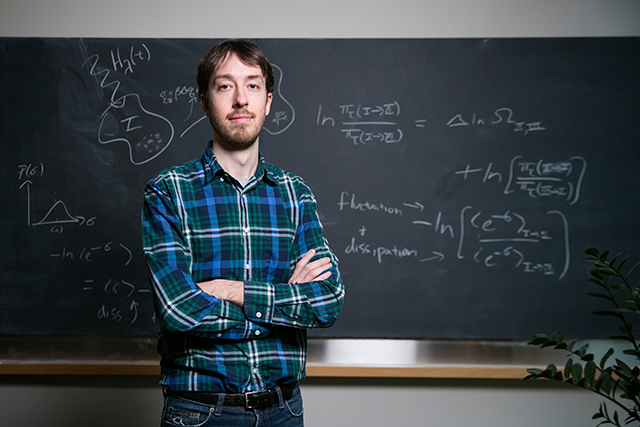
Jeremy England, an assistant professor at MIT, has a new theory published.  Here's an excerpt from Quanta Magazine:

"... indicates that when a group of atoms is driven by an external source of energy (like the sun or chemical fuel) and surrounded by a heat bath (like the ocean or atmosphere), it will often gradually restructure itself in order to dissipate increasingly more energy...you start with a random clump of atoms, and if you shine light on it for long enough, it should not be so surprising that you get plant..."


For further info, listen to one of his multiple talks or you can look at his published paper "Statistical Physics of Self Replication".


Rosetta Findings Add to Debate of How Water Arrived on Earth
The more comprehensive findings of the comet that Philae has landed on is yet to be released; it takes about a year for the best quality pieces to be observed, analyzed, tested and written about.  However, an interesting one has already come out and it's caused enough of a stir that it's been reported by the weathernetwork.com. One of the more popular hypothesis of the origin of our water is that it came from comets and asteroids - but this more scientific description from NASA has been written here and they've concluded that water from comets such as the one they're studying now couldn't have been the source of our water.  The water at this comet has 3 times the amount of deuterium than our Earth water.


The Importance of Writing in Science
As we are closing to the end of the course, Mr. McCumber and I will be asking for some of your feedback on the organization of the course.  I understand that it may have been writing heavy for some of you, but even post-secondary education is slowly putting some emphasis on the writing as can be seen in this article from the Atlantic.

"Scientists need to know how to write to get their work published and get grants—it's an important skill that people assume they already have [once they reach a certain level], so no one ever teaches them how to write well in these specific formats...research is king, and it's important," she said, but over the past decade universities have started to pay more attention to the "soft skills" that scientists also need."

The Difference between Skeptics and Deniers
It's important to respect everyone's opinion.  Everyone is entitled to an opinion and so here is a bit of mine:  while some of those pro creationist essays I read over the past week had well-formed arguments and fall into the 'skeptics' of Darwin's evolution, others' essays fall into the "denier" category as further defined by a blog post over at Quarks and Quasars.

"Skeptics want evidence; they seek it; they find it; then they accept it. Deniers do not want real evidence and they won’t accept any if it is brought before them.  A person who rejects an idea that is backed by scientific evidence is a denier, and they are anti-science."

Alright, so that wraps up this week's post.  Let me know what you guys think.  Let's finish the last week strong!

Sunday, 23 November 2014

Summer Research Prize Opportunity

McMaster university is trying to encourage students to consider astronomy as a university program by offering a new summer research prize opportunity.  Since it's new -  very few people know about it - which increases your likelihood that you will win a summer research position and $6200.  

Here are the details that I've received from Sara Cormier, the outreach coordinator (same position as Dr. Michael Reid in last week's guest lecture)  from McMaster: 

I just wanted to draw your attention to a brand new research prize for first year students offered by the Department of Physics & Astronomy at McMaster University. Current Gr. 12 students who are interested in applying to the Chemical and Physical Science I program (formally Physical Sciences I) and considering an Honours program in the Physics Department can apply.

What is it:
The prize is a paid research position in the Department of Physics & Astronomy working under the supervision of a faculty member. In the summer (2016) after their first year of university, the prizewinner will work full time for 16 weeks in a research laboratory or theoretical group. The nominal value of the prize is $6200 plus an early start on their research career!


Applications are open now and will remain open until January 31st. Students interested in applying are asked to submit an essay describing a project related to physics, astronomy or biophysics that they have been involved in, and how it has shaped their interest in physics and astronomy. Possible examples are a science fair project, culminating task, lab experiment, volunteer position, special interest, lecture or event, club or competition, co-op placement. The essay must be 500 words or less. Applicants will be judged on their written responses and entrance average. Grades submitted with their program application will be used. 


The online application website can be accessed through www.physics.mcmaster.ca and clicking on the link "Chemical and Physical Sciences Entrance Prize in Research", you can also access it directly here. I've also attached a PDF of our advertisement poster if you would like to post in your classroom.

Tuesday, 30 September 2014

Other Layer B Awards


Best Hand Drawn Infographic

This infographic has tremendous thought and planning behind it.  Not only is it visually stunning with its cubic cleavage, it is organized and laid out so that it is useful for anyone trying to identify any minerals.  When one first encounters a mineral, one visually inspects the mineral first which is why the artist puts visual properties on the left.  The infographic has minimal, well chosen words and aided the explanations with objects allowing the reader to quickly get an idea of what each mineral test entails.  The infographic was pretty exhaustive and informative.  The only issue I have with it is that the artist labelled 'chemical properties' under physically identifying minerals.  

Best App-Aided Infographic


This was an infographic that was done by piktochart.  There was a lot of information found in this infographic and it was also well organized.  It was visually fun to look at but my main comments to the artist was to cut down on the number of words to let your audience flow through the infographic.  Put some effort in summarizing each test so that your reader can get the main idea.  

Best Concept Map


Exhaustive and an all-encompassing concept map.  You want to know how all the key words are connected in the unit?  Look no further than this.  It is well planned,  visually laid out, and many interconnections between different concepts are present.  Absolutely spectacular work.    

Best use of Statistics - Showing what an Infographic Really Should Include (RESEARCH!)


See the full infographic here.  

There should have been some stats that you guys have researched about minerals.  ie:  What % of minerals have a hardness of 1?  What % of minerals are green?  Stats are integral aspect of an infographic - do some research and put it in there if you choose to do an infographic next round.  I encourage you to take look at this infographic and to see the interaction level of this artists' work.  

Monday, 22 September 2014

The First Formative Blog Awards

Thank you to all who have completed their very first blog post.  I understand there was some trepidation among some of you, but we all pretty much took the dive and started to write.  It was definitely interesting to read as I got to learn about your personalities and what interests you in this course.  I learned about many different things including the rarest mineral on Earth, that diamonds can be coloured, and the biggest star that we've discovered(it's huge).  I have feedback for each of you, and hopefully it will take you to the next level.

Another method of taking your blog to the next level is by reading your fellow classmates' work.

I'd like to take this moment to highlight some spectacular  blogs authored by some of our classmates. Many of you have worked hard to try to meet the expectations highlighted by the rubric and it's important to illustrate what they've done so that we may learn from it.


Best Overall Blog 
In Annieway, the attention to detail on the layout of the blog is especially apparent in her background choice. Not only does this background choice visually stunning, but it corresponds with her equally fantastic blog post regarding light pollution. She has posted a couple different things, demonstrating that she knows that she is to use this blog not only as an assignment posting medium, but also as an ideaboard for anything that she finds interesting earth and space wise.

Best Post
Earthy-Spacey is simultaneously informative as well as highly entertaining.  I had to reread many sentences to fully understand his many allusions and metaphors that showcase his interesting personality. Wow, just wow.    

Best Integration of Knowledge from Another Course
In Wandering Attention, AW asked an important question in class that I couldn't answer to her satisfaction.  She used her blog 20 time to explore the answer to that question and it led her to some chemistry concepts learned in grade 11 as well as some biology in grade 12.  Check it out!

Best Blog Incorporating Pop Culture
AF blogged about the possibility of a double sun as seen in Star Wars.  He explains what we, the common audience, understands - the single sun solar system.  He naturally transitions to a recent finding of the Hubble Space telescope, the binary star system and explain what he has learned about it.  Although I'd like to have seen some more scientific detail or exploration, AF takes home the best blog incorporating pop culture by successfully balancing pop culture and science content.  
 
By the way, there is such a thing as blog awards for some countries.  Here's Singapore's big blog award gala event as well as Ireland's. It's pretty serious. 

Saturday, 20 September 2014

Lab Fail...for Now.

Behold, the lab that both Mr. McCumber and Mr. Shin set up & tried ahead of time.  Alas, no students chose to perform the lab or do any observations. We set it up, but didn't sell it well as a worthwhile option.


Well, it was at least fun.  Maybe we'll incorporate it in the next unit.

Thursday, 18 September 2014

First Lab - Covering up Mistakes with Another Mistake is a Severe Mistake

So, I decided to trust my mature grade 12 students and do a "free for all" lab.  Rather than giving step by step instructions, I gave them a question and let them make the procedure.  The theory goes that they learn more with less help.

"Help students by helping them less" Or more popularly, Dan Meyer's "Be less helpful".   There's a reason why teachers rarely do this.

Things go wrong.  Chaos ensues.  Confusion reigns.  It's messy learning.  Apparently, real learning occurs through mistakes.  Let's analyze these mistakes:

Mistake #1:  Broken Glass
To find the volume of the rock, some of my smarter students placed and slid rocks inside graduated cylinders. However, other students dropped rocks into the graduated cylinders.  It doesn't seem so bad unless I tell you that the graduated cylinders were made of glass.

A broken graduated cylinder is no problem.  Usually what happens is that the student tells the teacher.  The teacher turns this accident into a learning moment by getting the attention of the class and telling people not to drop rocks in glass.  The teacher can make sure the area is clean of all the glass and most importantly, the mistake won't be repeated again.  But nope, this process didn't occur because another mistake was made.

                                     I'm not going to cry over spilled milk.  Or broken glass. Photo Credit: Creative Commons

Mistake #2:  Covering up a Mistake
Not telling your teacher and pretending the graduated cylinder didn't break can make things worse. Other students can slice their finger open.  The unreported broken glass is left around the area and can hurt the 8 year old students that come here for Chinese school at night.  All of this could happen because someone wanted to save their ego and not face the consequence of a broken graduated cylinder.  Sigh.

Mistake #3:  Broken Glass Redux
For an airplane to crash, it's been analyzed in Gladwell's book Outliers that about seven seemingly small sequential wrong mistakes lead up to the huge accident.  Thank goodness we're only at mistake #3.  Because we as a class didn't get to reflect on our mistake, person #2 dropped another rock into a graduated cylinder, breaking a second graduated cylinder.  Or worse, the second set of broken glass occurred because of person #1.

Summary

What's interesting is that the root of the problem is me.

I realized this when cleaning up afterwards.  I was looking in my prized box of 75 rocks and minerals and realized that they were all placed upside down and out of order.  I spent an extra 15 minutes combing the area for any broken glass.  I cleaned up the water by the sink.

It's one thing to let the students make their own procedure.  It's quite another to not set the proper tone of the lab to be one of respect for the learning environment and its materials.

"Being less helpful" doesn't have to mean "be less respectful."

Friday, 29 August 2014

Why are we blogging?

The topics and relevance of both earth and space science in today’s world is so vast that it cannotbe covered by the grade 12 textbook.  It is up to us to learn beyond the textbook and dig up the past, stay up to date with the present, and to predict and adjust for the future.

Blogging, like anything on Internet, can be time wasting, useless, and can have a negative effect on society.  However, with responsible use and with the right goals in mind, blogging and anything on the internet can be powerful tools for learning

Each week, you will be responsible for researching and blogging about a topic to take our learning beyond the textbook.   All you must do is find a video, topic, picture, quote, or discussion in class that you find interesting.  Then, research further and then blog about it.  It will serve as an ideaboard for future projects or research papers, as well as serve as a summative journal reflection piece (layer B) as you progress through the course.  Please see rubric. 

However, your audience will not only be me.  An important aspect of blogging is the community and its feedback.  We will be providing feedback to each other consistently to improve our blogging skills. 

When our writing has improved enough,  we will ask other teachers, professors, Masters/Ph D students, and even your parents to comment on your posts.  I have an agreement by the first year UT astronomy professor, Professor Mike Reid and a graduate student, to read and comment on a post of your choice later in the year. 


You are certainly free to post course related content as much or as little as you want.  After all, your blog posts are just a reflection of the learning that you want to get through this course.

However, after talking to a couple different professors, they need your writing to improve.  As a result, I will be looking to mark an in-depth blogpost on a biweekly basis according to the attached rubric.