It's getting closer to the winter break, so it was great to have some hands-on activities to add some spice to the classroom for my academics.
It seems like my applied class is getting all the engaging and interesting approaches to math, so this was quite refreshing for myself (and especially these academic kids) to have this tangerine activity to explore the surface area of a sphere.
First thing we did was take a good look at the tangerines and noted its differences from a perfect sphere. We then went on to talk about how perfect mathematical spheres don't exist in the real world since once one gets into the atomic level, things just aren't continuous. This sort of statement really bothered some of my students that one went home and told their parents.
Nevertheless, upon noting the clementines' (lack of) sphere-like properties, we proceeded to take a guess as to its surface area in terms of its radius, and thus area of its 2D ('projection'?) version. Each partner made their guess:
Looks like they their estimation skills are almost en par with my applied students' skills which has been honed through the Dan Meyer's 3-act process. That...or they looked at the formula sheet or remembered the answer from their elementary school days.
Let's see how they did:
I guess they couldn't be bothered to peel that other portion there to get its true surface area? I guess I should have done more teaching and less snapping of pictures here, as I could have demonstrated that by peeling the skin into smaller pieces would more accurately depict the surface area. Right now, much of the 'surface' area is used for the third dimension of height severely downplaying the true surface area of this orange.
That clementine there looks quite tasty. I must mark these students' self regulation skills to be excellent in their ability to stay on task without eating some juicy fruit.
Now that clementine looks quite symmetrical...and tasty.
Ahh, "four" circles! The 'true' answer.
Now this group featured a student who made the best notes ever and another student drew some of the best art on evaluations. The illustrations left behind were both profound and thoughtful. It's no small wonder that they took the time to rip the orange peels into symmetrical sizes to create the above work of art.
Anyways, this activity proved to be quite memorable. It's a good one and one that I'll continue to do every time I teach grade 9 as it somewhat demonstrates how the surface area of a sphere is 4πr^2 or the equivalent of the area of four circles.
I love to dance and sing. I coach ultimate Frisbee. I teach math and science to secondary school students. I love watching kids learn.
Wednesday, 16 December 2015
Tuesday, 15 December 2015
Capitalizing on the Hour of Code: An Alternative Assessment for Solving Equations
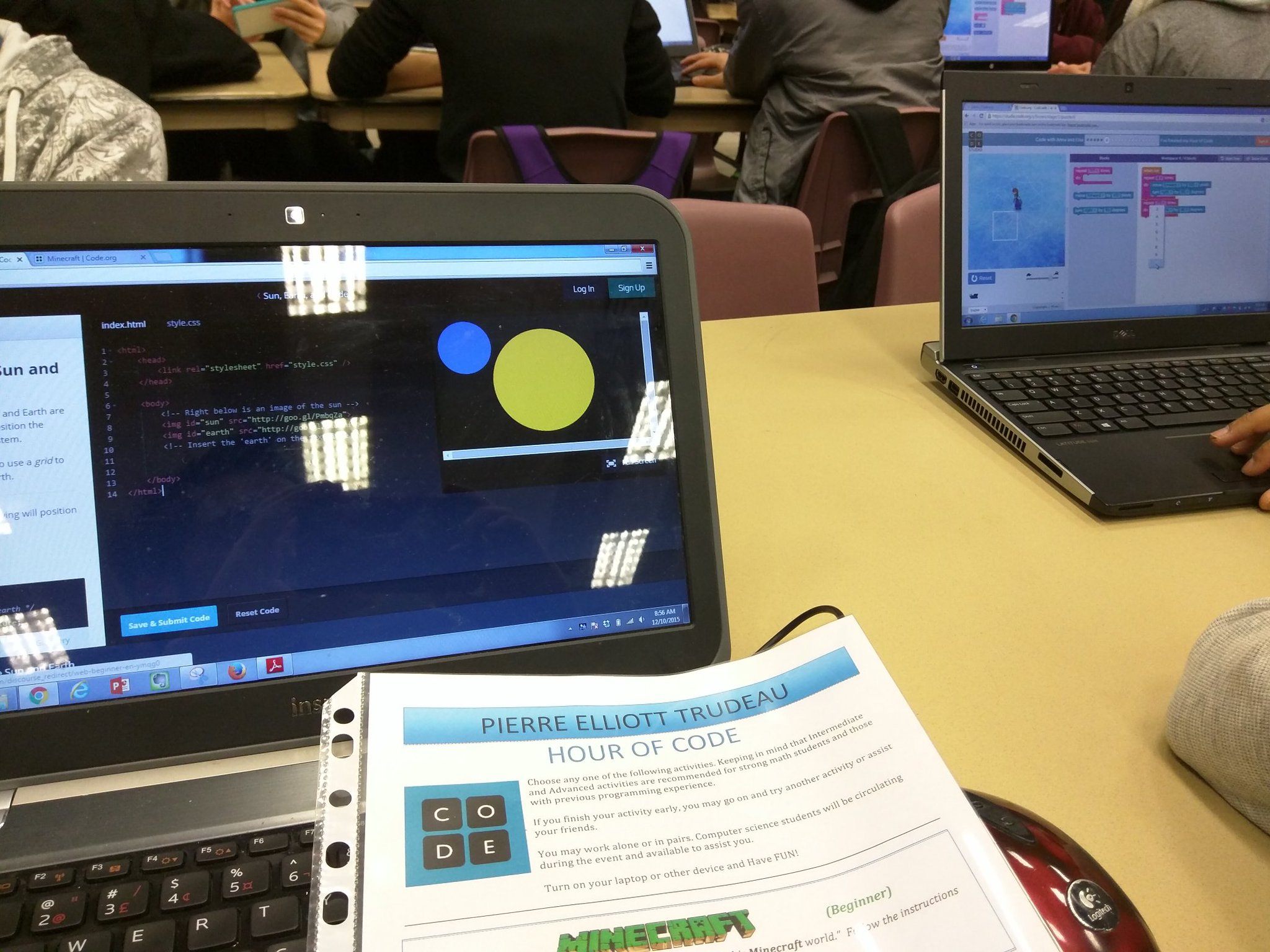
So last week was the Hour of Code. Our wondrous computer science teachers have decided to involve all the grade 9s and organized a tremendous time in the cafeteria involving 500 students. I had quite the fun myself as I tackled some good old HTML coding as well as some Star Wars programming.
I heard from a few of my 9 academic students that they've done this before, but they got a lot more out of this session than in previous years. They don't realize that maybe perhaps last year's experience set up today's success.
I wanted to integrate programming into the course. So I assigned some homework:
For homework the night before, I had given each student a different set of four numbers. With each of their four numbers, they were required to create their own 1 step, 2 step, and 2 step equations involving distributive property.
I then introduced my scratch assignment to my 9 applied math class using the previous week's Hour of Code as a springboard. Students are to make a multiple choice quiz on Scratch with the four questions they did as homework the night before. I had them start off with a template.
Some had a little hard time with this because 1) I didn't give them that much time to play with it (one official period only...and 2 other mini periods where they had a choice to study or do this assignment) and 2) it was introduced in the last week of before holidays when a few other assignments from other classes were due and 3) their reception for learning something completely new wasn't quite in this last week.
About a third of my class got it done perfectly. Take a look at this example.
Others don't know to check and debug. I know she can solve equations and build equations as I've assessed her separately on a previous test means that she hasn't debugged program properly:
Here's one student who went above and beyond by using the 30 minutes of introduction and probably previous programming experience to add some bells and whistles to the template I introduced to them:
There are some that have yet to hand it in.
I'm going to have to do some work after the break; I'll probably introduce some peer assessment process to help them go through the debugging process and then help the other 30% that didn't hand it in a little push. Should I add it to the rubric? Next semester.
I gave them a template, and they had to follow the instructions. It was mostly an exercise in creating their own equation, and then a matter of some data entry. However, the program's template isn't that intuitive, so inevitably, they have to learn the process of debugging and trying again. They experienced the confusion and pain associated with "programming" - and if they persisted, the joy of "programming" in a microcosm of one period.
I guess I can give myself a point for integrate programming into the math curriculum without having it take up more time than necessary. At the same time, it can be argued that they learned more about data entry than programming. I'll live with that - I've rarely been able to cover the curriculum well in an applied environment and to be able to do something new like this is quite a luxury - especially with the EQAO test next month.
Alternative assessment of the year? Done. Will I try it next semester? Let's see what my colleague says.
Anyways, here's the rubric (also attached) that I used:
https://drive.google.com/open?id=0BxWy_f8Du24JSDJkUVJqZTg1ZGs
I heard from a few of my 9 academic students that they've done this before, but they got a lot more out of this session than in previous years. They don't realize that maybe perhaps last year's experience set up today's success.
I wanted to integrate programming into the course. So I assigned some homework:
For homework the night before, I had given each student a different set of four numbers. With each of their four numbers, they were required to create their own 1 step, 2 step, and 2 step equations involving distributive property.
I then introduced my scratch assignment to my 9 applied math class using the previous week's Hour of Code as a springboard. Students are to make a multiple choice quiz on Scratch with the four questions they did as homework the night before. I had them start off with a template.
Some had a little hard time with this because 1) I didn't give them that much time to play with it (one official period only...and 2 other mini periods where they had a choice to study or do this assignment) and 2) it was introduced in the last week of before holidays when a few other assignments from other classes were due and 3) their reception for learning something completely new wasn't quite in this last week.
About a third of my class got it done perfectly. Take a look at this example.
Others don't know to check and debug. I know she can solve equations and build equations as I've assessed her separately on a previous test means that she hasn't debugged program properly:
Here's one student who went above and beyond by using the 30 minutes of introduction and probably previous programming experience to add some bells and whistles to the template I introduced to them:
There are some that have yet to hand it in.
I'm going to have to do some work after the break; I'll probably introduce some peer assessment process to help them go through the debugging process and then help the other 30% that didn't hand it in a little push. Should I add it to the rubric? Next semester.
I gave them a template, and they had to follow the instructions. It was mostly an exercise in creating their own equation, and then a matter of some data entry. However, the program's template isn't that intuitive, so inevitably, they have to learn the process of debugging and trying again. They experienced the confusion and pain associated with "programming" - and if they persisted, the joy of "programming" in a microcosm of one period.
I guess I can give myself a point for integrate programming into the math curriculum without having it take up more time than necessary. At the same time, it can be argued that they learned more about data entry than programming. I'll live with that - I've rarely been able to cover the curriculum well in an applied environment and to be able to do something new like this is quite a luxury - especially with the EQAO test next month.
Alternative assessment of the year? Done. Will I try it next semester? Let's see what my colleague says.
Anyways, here's the rubric (also attached) that I used:
https://drive.google.com/open?id=0BxWy_f8Du24JSDJkUVJqZTg1ZGs
Labels:
9 applied,
Andrew Shin,
assessment,
equations,
evaluation,
Hour of Code,
math,
mathematics,
MrAShinYRDSB,
PETHS,
Pierre Elliott Trudeau High School,
programming,
Scratch,
solving equations
Thursday, 10 December 2015
A Student Teacher, Teaching the Teacher
A Lesson on Felicia
I have ALMOST given the full reins to my student teacher
lately every Thursday when she comes to volunteer.
I use the word ‘almost’ because a student teacher never
truly has their classroom management tested as they’re walking into a classroom
with established norms and systems in place that hopefully protect
supply/student teachers.
I’m also in the room while she teaches, which affects the
management of the classroom.
On a separate note, for the
first time in eight years, I can say that my applied classroom norms extend
strongly even when I have a supply teacher (given the comments they leave behind).
That’s how receptive my students are this year.
That just means that next year, my students will be wild and
out of control, doesn’t it?
On the other hand, my student teacher is incredibly
talented and is in her final year of teachers’ college. I have learnt much from her style, approach
and her creativity; case in point, take a look at her lesson on Felicia that
she made up:
The question, I could see, resonated with the girls in my
classroom. I
guess after questions involving video games, Usain bolt, etc. this was
something new.
My student teacher and I coordinated through my spiral
curriculum well as the question was just a touch out of their comfort zone as
they just finished learning solving equations and we’ve been through perimeter
and area about two times before in previous spirals.
The question was challenging as they got into groups of two
or their ‘rate of change’ partners. This
question demanded the large whiteboards.
For some reason, the students have been naturally lately
looking to group their pairs into group of 4s and 6s. I immediately broke up the group of 6 as I
know that group was just too large. I
let the group of 4 stay as I knew that particular group of 4 worked well. I still, prefer pairs, so I'll probably split them up next time.
However, I wanted to see how well they worked and learnt;
the next day, I went over it briefly and summarized positives and negatives of
each group in terms of their process work, communication, without stating the
answer.
To truly assess how well they worked, I put up the question
again. Now, usually I am not a fan of
re-doing a question, or re-assessing the same question, giving multiple
opportunities, and doing it in groups…but I’ve been reading so many positive
reviews of it that I decided to truly try it again.
It actually worked.
For thinking style type questions, putting the students in
groups and allowing multiple opportunities created an environment of
learning. The majority of students
actually tried it on their own (except the bottom 5% of the class where collaboration occurred immediately..) before
starting to compare answers. Upon
finding differences, these students went through learning conversations where
they justified each other’s work.
For a question that we did yesterday and that I took up
earlier, it took almost 20 minutes to get it done. Some students didn’t even finish. I guarantee you, as I walked around the
classroom listening to their conversations, none of them were fooling around.
Mind you, I still hesitate at the thought of doing summative
thinking questions in groups with my academic students because I know the ‘Mr.
Shin caught your mistake’ current environment I’ve set up would cause more of
my students to copy off other students as opposed to learning it.
I am really going to have to rethink my teaching as I found
that those rich discussions that the students had with each other is worth
designing the curriculum for.
What’s hilarious is that the education world made this
discovery about math education about 5 years ago when Dan Meyer first landed in
a TedX talk. Education has already moved
on from this to the next phase – but at this point, the latest stuff is too progressive and
far left reaching for me. I've never been an innovator; I've always been a late adopter myself to make sure the 'latest' trend actually sticks around and works with the common teacher.
Maybe if I was an elementary school teacher, I would make
the jump ASAP to the latest educational trend; but as a secondary school teacher where post secondary
institutions require a certain level of standardized skill, I don’t think I
could ever make that jump.
Maybe in another 5 years I’ll make the switch if it has proven to be more than the latest trend.
Things just move so fast.
Anyways, I’d like to take this opportunity to thank my student teacher for using her beautiful question as a springboard into student learning
as well as mine.
Labels:
3 act,
3 Act Math,
9 applied,
Andrew Shin,
equations,
evaluation,
math,
mathematics,
MrAShin,
MrAShinYRDSB,
PETHS,
Pierre Elliott Trudeau High School,
solving equations,
spiral curriculum
Monday, 7 December 2015
Success! Students Create, Solve, and Assess Equations all on Their Own
I just marked the students' test on spiral #9 which included a) volume of pyramids and b) solving equations.
Volumes of Pyramids
16/22 members of this applied math class achieved level 4 or higher on this multi-step pyramid that involved using the pythagorean theorem first. Since this is the third time spiraling through pythagorean theorem, this high success rate is not surprising.
Solving Equations
Regarding the solving of equations - take a look at what they produced on the test:
Needless to say, they aced the other questions where they had to solve my equations. However, their formal LS and RS checks needed a little work, and during their reassessment next week, they hope to capture that portion of the test.
It shows that the formative peer work they did the day before worked. I didn't have to do any marking to provide the feedback that they needed. This community that the students have created in the past 3 months have allowed them to embrace their mistakes. The amount of learning was exponential as the students were making their own questions on their whiteboards and discussing with each other their own individual problems. They found each others' mistakes and they would justify to each other why it was a mistake.
Some students thought that a decimal/fraction answer was a "mistake"; they went back and "corrected" the question that they created so that the solution was an integer. The process of critical thinking necessary to justify and correct it was fun to watch; however, I have put in a mental note for the students' need that a real number (non-integer) is a number too.
I'm glad that none of my students have stated any racist or sexist or any other inappropriate comments; but they certainly are 'fractionists'. I have to figure out a way to expand their thinking on this one.
The whiteboards' non permanent surface is a boon for students as there is no eraser mark, white-out, or need for an official eraser. It encourages students to just write out their thoughts, display their thinking, and promote discussion.
I wish I had employed the spiral curriculum since my first year of teaching with these applied students, as this success rate has been absolutely unbelievable.
At the same time, I have a couple factors that are exaggerating the spiral curriculum's success:
1. I have motivated kids. My level of engagement is even higher than that of my academic classes. Dan Meyer's 3 act math had something to do with that.
2. I have students with extremely strong learning skills this year. My classroom management micromanaging at the beginning has paid off continual dividends that the students reap every day.
Volumes of Pyramids
16/22 members of this applied math class achieved level 4 or higher on this multi-step pyramid that involved using the pythagorean theorem first. Since this is the third time spiraling through pythagorean theorem, this high success rate is not surprising.
Solving Equations
Regarding the solving of equations - take a look at what they produced on the test:
Needless to say, they aced the other questions where they had to solve my equations. However, their formal LS and RS checks needed a little work, and during their reassessment next week, they hope to capture that portion of the test.
It shows that the formative peer work they did the day before worked. I didn't have to do any marking to provide the feedback that they needed. This community that the students have created in the past 3 months have allowed them to embrace their mistakes. The amount of learning was exponential as the students were making their own questions on their whiteboards and discussing with each other their own individual problems. They found each others' mistakes and they would justify to each other why it was a mistake.
Some students thought that a decimal/fraction answer was a "mistake"; they went back and "corrected" the question that they created so that the solution was an integer. The process of critical thinking necessary to justify and correct it was fun to watch; however, I have put in a mental note for the students' need that a real number (non-integer) is a number too.
I'm glad that none of my students have stated any racist or sexist or any other inappropriate comments; but they certainly are 'fractionists'. I have to figure out a way to expand their thinking on this one.
The whiteboards' non permanent surface is a boon for students as there is no eraser mark, white-out, or need for an official eraser. It encourages students to just write out their thoughts, display their thinking, and promote discussion.
I wish I had employed the spiral curriculum since my first year of teaching with these applied students, as this success rate has been absolutely unbelievable.
At the same time, I have a couple factors that are exaggerating the spiral curriculum's success:
1. I have motivated kids. My level of engagement is even higher than that of my academic classes. Dan Meyer's 3 act math had something to do with that.
2. I have students with extremely strong learning skills this year. My classroom management micromanaging at the beginning has paid off continual dividends that the students reap every day.
Sunday, 6 December 2015
Hooking Students into Solving Equations
As I approached this topic - it scared me. Typically, my 9 applied students don't take this concept of solving equations very well.
However, it went extremely well. Better than I thought.
All my work emulating Dan Meyer has paid off, as they gobbled up this math lesson with such focus and creativity that amazed even me.
The community of openness, willingness to make mistakes, and the growth mindset was on full display.
I started off with the typical Pearson textbook problem on a Powerpoint, and had them figure out in any method how many spheres are in the bag, assuming that this was a balance. It's my attempt at having them recall some prior knowledge:
Then, I had them try out this question:
I asked them - "What is the difference between this question, and the previous question?"
Student: "It's more complicated."
Mr. Shin: "Yes it is more complicated. There are many ways that this question is more complicated. Can someone elaborate on why the second question is much more complicated?"
Students: "Uhh...more spheres, more items, and more bags on both sides."
I then went on to explain that there's a method to "simplify" (bad term to use, I'll admit. I have to ask my colleagues for the proper term. They're much smarter than I on the formal aspects of mathematics) complicated equations like the second picture to become simpler equations like the first picture above.
A little bit of a hook was made to some students, but as usual - not all. Well, at least I got some without having to use any symbols or use of any math.
At this point, though, I had to introduce the use of symbols to solving simple equations on solving equations. I made sure though, that they as a class were able to predict each math line that would pop up on the Powerpoint before I flashed each line on the screen.
Continuing on to use think pair share and whiteboards for the next two questions makes sure that at least half of my 22 students are able to get some portions of this concept.
On day two, we built equations. They made up their own equations using cups and cubes. I also encouraged them to draw out questions for their partners.
Talk about students being leaders in their learning - giving them the responsibility to create their own questions. Fractions and decimals came out as partners answers others' questions - it was very interesting that they would take it back and try to 'fix' it as if there are problems with fractions.
However, going through that exercise of integer answers only really made them think creatively.
This is why I like the applied classroom - they take liberties on things like the money bags up top and even this:
Bunny rabbits and money bags are so much more interesting than spheres. Money bags is better conceptually though, than the rabbits who have eaten candies, but at least they're taking their artistic liberties.
And...they're really into it - a few of them started on their homework from Knowledge Hook right away on Friday night, and there is NO red square so far. One video was watched for clarification so far...good news good news.
I guess the real test is: how many more 9 applieds will they even attempt their homework by Monday?
Stay tuned!
However, it went extremely well. Better than I thought.
All my work emulating Dan Meyer has paid off, as they gobbled up this math lesson with such focus and creativity that amazed even me.
The community of openness, willingness to make mistakes, and the growth mindset was on full display.
I started off with the typical Pearson textbook problem on a Powerpoint, and had them figure out in any method how many spheres are in the bag, assuming that this was a balance. It's my attempt at having them recall some prior knowledge:
Then, I had them try out this question:
I asked them - "What is the difference between this question, and the previous question?"
Student: "It's more complicated."
Mr. Shin: "Yes it is more complicated. There are many ways that this question is more complicated. Can someone elaborate on why the second question is much more complicated?"
Students: "Uhh...more spheres, more items, and more bags on both sides."
I then went on to explain that there's a method to "simplify" (bad term to use, I'll admit. I have to ask my colleagues for the proper term. They're much smarter than I on the formal aspects of mathematics) complicated equations like the second picture to become simpler equations like the first picture above.
A little bit of a hook was made to some students, but as usual - not all. Well, at least I got some without having to use any symbols or use of any math.
At this point, though, I had to introduce the use of symbols to solving simple equations on solving equations. I made sure though, that they as a class were able to predict each math line that would pop up on the Powerpoint before I flashed each line on the screen.
Continuing on to use think pair share and whiteboards for the next two questions makes sure that at least half of my 22 students are able to get some portions of this concept.
On day two, we built equations. They made up their own equations using cups and cubes. I also encouraged them to draw out questions for their partners.
Talk about students being leaders in their learning - giving them the responsibility to create their own questions. Fractions and decimals came out as partners answers others' questions - it was very interesting that they would take it back and try to 'fix' it as if there are problems with fractions.
However, going through that exercise of integer answers only really made them think creatively.
This is why I like the applied classroom - they take liberties on things like the money bags up top and even this:
Bunny rabbits and money bags are so much more interesting than spheres. Money bags is better conceptually though, than the rabbits who have eaten candies, but at least they're taking their artistic liberties.
And...they're really into it - a few of them started on their homework from Knowledge Hook right away on Friday night, and there is NO red square so far. One video was watched for clarification so far...good news good news.
I guess the real test is: how many more 9 applieds will they even attempt their homework by Monday?
Stay tuned!
Saturday, 5 December 2015
Defeat Breast Cancer!
Teaching is something that I absolutely love; its rewards are sometimes tangible, often instantaneous, and can be endless.
Coaching is also immediately gratifying, and its results are endless AND tangible. I started tryouts for ultimate frisbee yesterday morning at 7am - 8am, just before class started. One of my former students came back to help organize tryouts and more are on their way as they finish off their exams.
Dancing - I enjoy in itself. I danced yesterday, sacrificing 20 minutes of period 2,3, and 4 to raise awareness and money vs breast cancer. This is the 6th year in a row I've done it. Although the stage was closed, it was better we performed on the floor as we were closer to the crowd. I was able to feed off the crowd a lot more. Even my mistakes, I was able to laugh them off this year as opposed to years past.
We have been practicing this dance for 4 weeks now and as always, it was worth it in the dancing itself, but also to help Trudeau's STRUT club promote awareness and raise money against breast cancer.
The best thing about this dance was that it was organized, choreographed by a couple of students. It's a small portion of what happened this whole week as they've been selling popcorn, cookies, and raising awareness throughout this Pink Week. Anyways, if you'd like to see the fruits of our students' work, here it is:
Coaching is also immediately gratifying, and its results are endless AND tangible. I started tryouts for ultimate frisbee yesterday morning at 7am - 8am, just before class started. One of my former students came back to help organize tryouts and more are on their way as they finish off their exams.
Dancing - I enjoy in itself. I danced yesterday, sacrificing 20 minutes of period 2,3, and 4 to raise awareness and money vs breast cancer. This is the 6th year in a row I've done it. Although the stage was closed, it was better we performed on the floor as we were closer to the crowd. I was able to feed off the crowd a lot more. Even my mistakes, I was able to laugh them off this year as opposed to years past.
We have been practicing this dance for 4 weeks now and as always, it was worth it in the dancing itself, but also to help Trudeau's STRUT club promote awareness and raise money against breast cancer.
The best thing about this dance was that it was organized, choreographed by a couple of students. It's a small portion of what happened this whole week as they've been selling popcorn, cookies, and raising awareness throughout this Pink Week. Anyways, if you'd like to see the fruits of our students' work, here it is:
Tuesday, 1 December 2015
Old Style Education vs the New Style Education
We are at a crossroads for learning. Students are very good at informal learning; their interests lead them to finding resources on the internet to learn more about their interest. This is in contrast to the formalized learning that happens in school sometimes. Some students can bridge these two styles of learning; other students aren't successful at formal education or don't see the point in school.
Many teachers prefer the traditional method of education with the teacher at the front leading the classroom. Students don't know what they don't know and it's important that the teacher impart some of the perspective, experience and knowledge through interesting media.
However, there are more and more voices from the progressive teachers (which are mostly online) with this view that I found on flickr:
Others prefer student lead learning with teachers as facilitators. The epitome of student led learning and teacher facilitation is depicted in the makerspace below:
Content doesn't matter as much, as we now have access to knowledge all the time with the internet.
Skills matter more. With the makerspace, students are creating things. With this higher engagement, the important skills of initiative, collaboration, and perseverence are all practiced at a much higher level. Developing these soft skills will enable them to succeed at whatever job they are placed in.
It essentially boils down to this: do we try and give students a base knowledge to start with or do we just let them lead their own education?
The answer is always the same to these new initiatives: mix i the old with the new. I will do both because students will benefit from both. I just hope I know how to balance it and if the time allocation is done correctly.
Very often, students don't know what they want to learn because they haven't discovered it yet. For these students, it is my job as a teacher to show them the amazing parts of this world. Once their interest has been captured, then it's my turn to facilitate and lead from behind and let the students lead the way.
Many teachers prefer the traditional method of education with the teacher at the front leading the classroom. Students don't know what they don't know and it's important that the teacher impart some of the perspective, experience and knowledge through interesting media.
However, there are more and more voices from the progressive teachers (which are mostly online) with this view that I found on flickr:
Others prefer student lead learning with teachers as facilitators. The epitome of student led learning and teacher facilitation is depicted in the makerspace below:
Content doesn't matter as much, as we now have access to knowledge all the time with the internet.
Skills matter more. With the makerspace, students are creating things. With this higher engagement, the important skills of initiative, collaboration, and perseverence are all practiced at a much higher level. Developing these soft skills will enable them to succeed at whatever job they are placed in.
It essentially boils down to this: do we try and give students a base knowledge to start with or do we just let them lead their own education?
The answer is always the same to these new initiatives: mix i the old with the new. I will do both because students will benefit from both. I just hope I know how to balance it and if the time allocation is done correctly.
Very often, students don't know what they want to learn because they haven't discovered it yet. For these students, it is my job as a teacher to show them the amazing parts of this world. Once their interest has been captured, then it's my turn to facilitate and lead from behind and let the students lead the way.
Subscribe to:
Posts (Atom)