The second spiral was a short introduction to relations. I started off with the concept of a rate, and created my own version of the "pumping gas" problem from Mr. Orr's "tap into teen minds".
One of the best things that Mr. Dan Meyer stated about this was how the video can be used as a 'hook'. Boy, did I underestimate the power of this hook. Combine this hook with open ended questions, and Dan Meyer was absolutely correct - all sorts of learners participated, even the weaker math students.
The video even out the playing field and it was magical to have such engagement in an applied classroom. In all of my eight years of teaching (I know, I'm young), I have never, ever seen this.
Another thing that has me pleasantly surprised - were the questions being asked.
"What car is it?"
"How many litres can your car hold?"
"How many litres did you put in?"
"How big is your car?"
"How much did you pay?"
It is so intriguing as some of these questions did not come to my mind, yet each of them are indeed connected to math. In many ways, my converging mindset could only think of the one question I really wanted (ie: what is the price of gas per litre?) I must work on my divergent thinking.
After a day of rates, we went on to the topic of scatterplots. Now understanding the importance of a hook, I started the students off with a 30 second paragraph of Tyler Vigen's graphs of spurious correlations
The causality vs correlation issue is often a huge source of consternation for those who frequent the forums online, and I just wanted to introduce this common pitfall.
Hence, my Friday assessment of scatterplots and rates was chicken and crude oil related, much to the delight of some of my students. Or chagrin. I'm still learning to read some of them one month through.
On a side note, a few of my students were trying to force a connection in this above relationship depicted by the line graph to make sense and ventured a hypothesis thinking that the chicken was being cooked in the crude oil.
My mind is still blown that I have such a high engagement level.
I'm proud of the students. Let's see how long we can keep this up.
Look ahead: I'm spiraling back to the Pythagorean theorem by starting off week 4 with perimeter of composite shapes. Now that we've completed an initial assessment and a reassessment of week 1, I know exactly who to target tomorrow for individual help. This is an incredible advantage of the spiral curriculum.
I love to dance and sing. I coach ultimate Frisbee. I teach math and science to secondary school students. I love watching kids learn.
Monday, 28 September 2015
Tuesday, 22 September 2015
Assessment of the First Spiral
Even though I've been teaching for eight years now, I turned everything absolutely upside down. I'm now working with a spiral curriculum, performing Dan Meyer's 3-act math on a regular basis and implementing some serious classroom management techniques that was recommended to me from my last year's mentee.
My first spiral which consisted of Pythagorean theorem, perimeter, collecting like terms, polynomials, area and distributive property was a success by my books thus far. They did well on certain portions of their assessment, but other not so well. I crunched a lot of material in 1.5 weeks, and they struggled with the last portion - distributive property. Or rather, I didn't give enough time to allow for the students to work with it.
Nonetheless - I borrowed some growing success initiatives from my science department, my wife, and another math colleague.
1) An adaptation of my science department's concurrent credit recovery policy,: if the students failed the assessment overall, they could get a second hack at the assessment. They must perform at a level 3 (~70%) for me to bring their marks (all of K, A, T, C) up to 50%.
2) Wife: Since I was devoting class time for students to have a second hack at the assessment, I allowed the other students to try to upgrade one question. My one page double sided assessment had a couple of thinking questions - one from homework which I took up and another one that was a little extension. As a result, all of my students had 'something' to work on.
3) After going through the whole assessment, students can choose to look in their binder to help them with any question that they may have trouble with. I've been trying to give students incentive to keep an organized binder, and especially with this spiral curriculum, we have topics everywhere. Well, armed with their organized binders, students can now use their binder (at the cost of 50% of the mark for the particular question), students can now and try to get the remaining 50% of the question.
My first spiral which consisted of Pythagorean theorem, perimeter, collecting like terms, polynomials, area and distributive property was a success by my books thus far. They did well on certain portions of their assessment, but other not so well. I crunched a lot of material in 1.5 weeks, and they struggled with the last portion - distributive property. Or rather, I didn't give enough time to allow for the students to work with it.
Nonetheless - I borrowed some growing success initiatives from my science department, my wife, and another math colleague.
1) An adaptation of my science department's concurrent credit recovery policy,: if the students failed the assessment overall, they could get a second hack at the assessment. They must perform at a level 3 (~70%) for me to bring their marks (all of K, A, T, C) up to 50%.
2) Wife: Since I was devoting class time for students to have a second hack at the assessment, I allowed the other students to try to upgrade one question. My one page double sided assessment had a couple of thinking questions - one from homework which I took up and another one that was a little extension. As a result, all of my students had 'something' to work on.
3) After going through the whole assessment, students can choose to look in their binder to help them with any question that they may have trouble with. I've been trying to give students incentive to keep an organized binder, and especially with this spiral curriculum, we have topics everywhere. Well, armed with their organized binders, students can now use their binder (at the cost of 50% of the mark for the particular question), students can now and try to get the remaining 50% of the question.
Thursday, 10 September 2015
Intro to Pythagorean Theorem
Today, I have officially decided to follow and jump on the Dan Meyer bandwagon by introducing a problem using his 3-acts. However, I have more specifically jumped on Mr. Orr's bandwagon, as he seems to be the Canadian version of Dan Meyer from what I've read on his blog.
To start myself off on this 3-act business, I have copied Mr. Orr's video on "Corner 2 corner" with this video below:
I requested that the students write down any questions that come to mind - even non-mathematical ones. I had some trouble amalgamating their questions as well as leading them to the question that did matter - but I have tremendous students that eventually got to the question I wanted: what's the length of the room from the top corner to bottom corner?
My favourite part of the whole exercise is the estimation portion. As per Dan Meyer, it's best to ask students to answer the following:
We then discussed a plan of how to find the length of the string. With some guidance, a couple got the concept. Reinforcement is definitely necessary tomorrow.
Instead of giving all the measurements, I felt that my 9s needed some movement - so I split them up into groups and they went about counting the tiles on the ground to calculate the width and length of the class.
We finished it off with some calculations and got the answer. We have two people who guessed very close to the answer!
I'd say my first 3-act execution was somewhat of a success. Let's hope I improve on the next one!
To start myself off on this 3-act business, I have copied Mr. Orr's video on "Corner 2 corner" with this video below:
I requested that the students write down any questions that come to mind - even non-mathematical ones. I had some trouble amalgamating their questions as well as leading them to the question that did matter - but I have tremendous students that eventually got to the question I wanted: what's the length of the room from the top corner to bottom corner?
My favourite part of the whole exercise is the estimation portion. As per Dan Meyer, it's best to ask students to answer the following:
- What's a number that's too low?
- What's a number that's too high?
- What's the exact measurement?
We then discussed a plan of how to find the length of the string. With some guidance, a couple got the concept. Reinforcement is definitely necessary tomorrow.
Instead of giving all the measurements, I felt that my 9s needed some movement - so I split them up into groups and they went about counting the tiles on the ground to calculate the width and length of the class.
We finished it off with some calculations and got the answer. We have two people who guessed very close to the answer!
I'd say my first 3-act execution was somewhat of a success. Let's hope I improve on the next one!
Wednesday, 9 September 2015
Activating Prior Knowledge
Well - here I go, trying to spiral my way through 9 applied math. First day started with some serious structure laid down in hopes of preventing those inevitable fires that come about in the oncoming months.
As one of my favourite colleagues from MDHS often described teaching - it's "trench warfare out here." I certainly laid a dug a deep trench and it started well. My students and I battled the math together on the first day.
We started with some prior knowledge activation as was suggested by my fellow colleague Ms. Phan out in Ottawa-Carleton District School Board suggested that I do.
Here are some of the results of today's prior knowledge activation in which they tried to brainstorm as many topics as possible and categorize them under different levels of confidence.
As one of my favourite colleagues from MDHS often described teaching - it's "trench warfare out here." I certainly laid a dug a deep trench and it started well. My students and I battled the math together on the first day.
We started with some prior knowledge activation as was suggested by my fellow colleague Ms. Phan out in Ottawa-Carleton District School Board suggested that I do.
Here are some of the results of today's prior knowledge activation in which they tried to brainstorm as many topics as possible and categorize them under different levels of confidence.
Thursday, 11 June 2015
Spaces with Space with Volcanoes on the Pacific Rim
As you are approaching your final exams (not all of you...I'm looking at you grade 11s) with less than enthused study sessions, may I present to you some beautiful finds in the past month.
GoPro and SpaceX
SpaceX attached a GoPro camera to their falling module. Just to see the Earth in all of its beauty in the resolution and motion that a GoPro can capture makes me feel like I myself am floating on the edge of the atmosphere. The waltz music almost makes me forget about the heat and friction that accompany the falling back towards Earth - I was kind of looking forward to seeing that portion of the fall, but SpaceX elected to cut that out.
Feast your eyes, and then please go back to studying.
Star Party
Around 20 parents and students came on out two nights ago to watch Chris Vaughan of the Dunlop Observatory setup three telescopes to watch the night sky for almost 3 hours. He was such a wealth of knowledge taking us from a pair of binary stars to swans to even spotting the ISS. He masterfully had us observe Venus, then Jupiter, and then followed the ecliptic to find a third planet - Saturn! I look forward to working with Chris again, and hopefully we can book him for another season to observe a different night sky.
GoPro and SpaceX
SpaceX attached a GoPro camera to their falling module. Just to see the Earth in all of its beauty in the resolution and motion that a GoPro can capture makes me feel like I myself am floating on the edge of the atmosphere. The waltz music almost makes me forget about the heat and friction that accompany the falling back towards Earth - I was kind of looking forward to seeing that portion of the fall, but SpaceX elected to cut that out.
Feast your eyes, and then please go back to studying.
Star Party
Around 20 parents and students came on out two nights ago to watch Chris Vaughan of the Dunlop Observatory setup three telescopes to watch the night sky for almost 3 hours. He was such a wealth of knowledge taking us from a pair of binary stars to swans to even spotting the ISS. He masterfully had us observe Venus, then Jupiter, and then followed the ecliptic to find a third planet - Saturn! I look forward to working with Chris again, and hopefully we can book him for another season to observe a different night sky.
Volcanoes
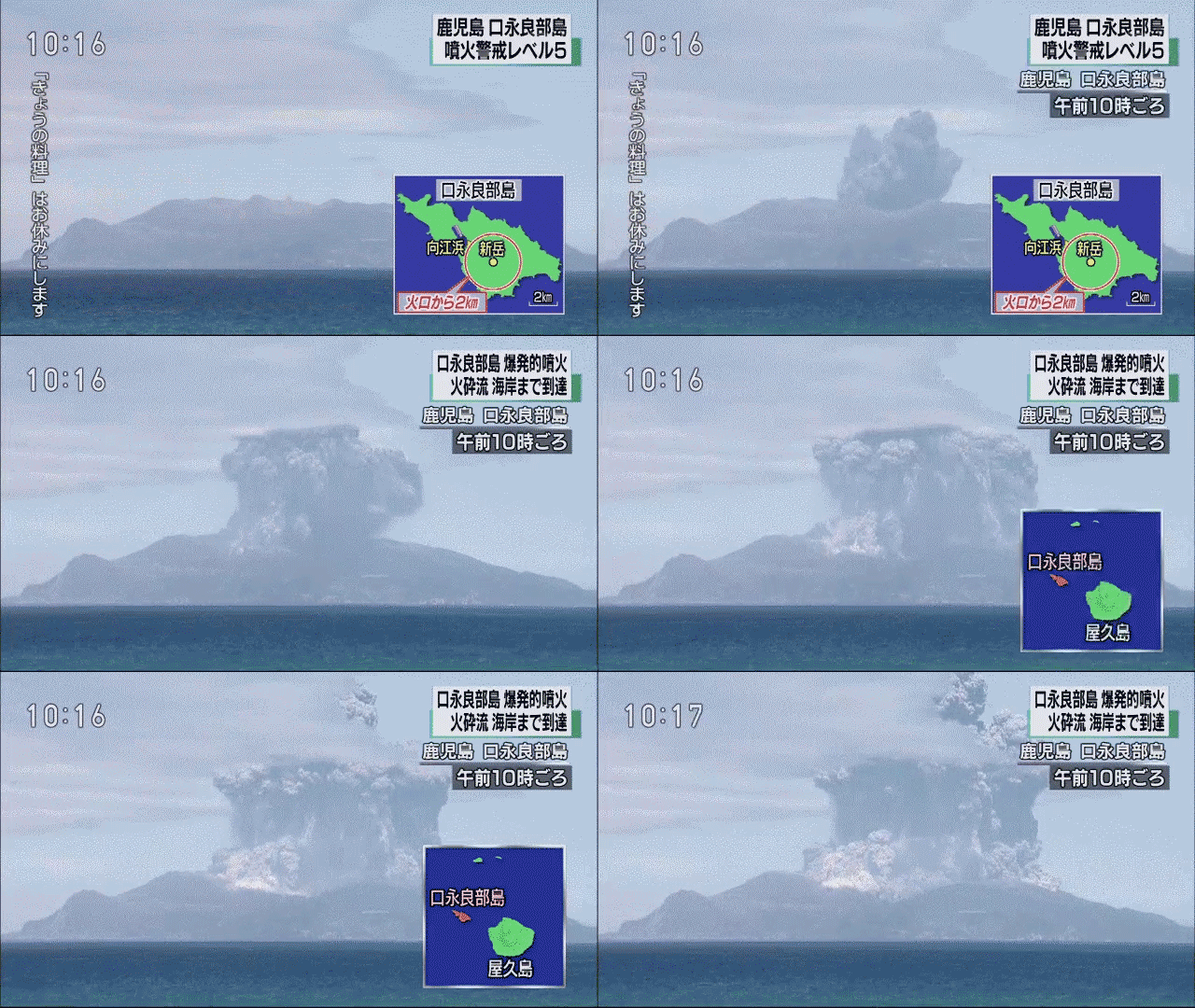
Remember how the study of Earth is also a part of the course? Did you hear that our guest Chris Vaughan (see above) couldn't get a summer job after first year when he didn't have any geology courses, but after second year in university where he elected to take geology courses, he and all of his friends got summer job offers? Don't neglect the geology portion of the course ladies and gents. Here is a reminder of the power of our very own Earth shown in this Mount Shindake volcano video in which Japan raised the volcano alert level to 5, which is the highest on the scale.
NASA Mission to Europa
Looks like there's a mission to Jupiter's moon and they've chosen 9 instruments to help determine if this moon is habitable. Guess which instruments they are? (we've studied a couple of them in class!)
Hey, you're still here? You should be studying...or blogging.
Thursday, 14 May 2015
Quakes, a Creationist Geologist, and Table Turning Planets
It's been a while, hasn't it? Senioritis is hitting the grade 12s in our class pretty hard, and it seems to be taking a toll on my blogging frequency as well. No matter how hard senioritis hits the students though, plate tectonics keep building stress, magma is rolling, and disasters strike. One must always work hard and be prepared.
I learned a lot this week from your presentations on past earthquakes and volcanoes. Great job everyone. The MA and OH's Chilean volcano coverage and LL and JL's Tongshan earthquake presentation really had me engaged throughout the twenty minutes.
Nepal
Nepal had a second major earthquake with a Richter magnitude of 7.3. It's been very difficult for help to reach the more remote areas of the mountains, and the transportation of emergency supplies has been slow as a result. An article was brought to mind as BL was performing his presentation where he creatively prepped us as volunteers: random volunteers of students, church congregations or anyone else who go to help out but who also lack skills or coordination can actually slow down the aid process. Sending money is the best thing we can do according to this article at the Guardian. Read this reflection on how volunteers who attempted to help out in Haiti may have slowed down the process.
Texas
1 earthquake in 58 years prior to 2008. Once fracking began, there have been over 100 mini earthquakes reported since 2008. An interesting correlation, is it not? Read more at CNN
A Refreshing Perspective
Finally, a creationist has stood up in our class to counter the views - albeit on paper, and not in class. One day, I hope to see a serious, respectful discussion regarding how a creationist views some of these scientific ideas we learn about. Nevertheless, here's a very different perspective - a geologist, who understands and believes in the stories that rocks tell us in terms of age (4.5 billion year old earth) and is bent on trying to reconcile Noah's great flood story with the rocks he studies. Read more here on his journey.
The Tables have Turned
Our current theory and understanding of planetary formation has been called into question by Australian National University as they have found found a larger exoplanet orbiting a smaller sun. Check it out here, on discovery.com!
I learned a lot this week from your presentations on past earthquakes and volcanoes. Great job everyone. The MA and OH's Chilean volcano coverage and LL and JL's Tongshan earthquake presentation really had me engaged throughout the twenty minutes.
Nepal
Nepal had a second major earthquake with a Richter magnitude of 7.3. It's been very difficult for help to reach the more remote areas of the mountains, and the transportation of emergency supplies has been slow as a result. An article was brought to mind as BL was performing his presentation where he creatively prepped us as volunteers: random volunteers of students, church congregations or anyone else who go to help out but who also lack skills or coordination can actually slow down the aid process. Sending money is the best thing we can do according to this article at the Guardian. Read this reflection on how volunteers who attempted to help out in Haiti may have slowed down the process.
Texas
1 earthquake in 58 years prior to 2008. Once fracking began, there have been over 100 mini earthquakes reported since 2008. An interesting correlation, is it not? Read more at CNN
A Refreshing Perspective
Finally, a creationist has stood up in our class to counter the views - albeit on paper, and not in class. One day, I hope to see a serious, respectful discussion regarding how a creationist views some of these scientific ideas we learn about. Nevertheless, here's a very different perspective - a geologist, who understands and believes in the stories that rocks tell us in terms of age (4.5 billion year old earth) and is bent on trying to reconcile Noah's great flood story with the rocks he studies. Read more here on his journey.
The Tables have Turned
Our current theory and understanding of planetary formation has been called into question by Australian National University as they have found found a larger exoplanet orbiting a smaller sun. Check it out here, on discovery.com!
Tuesday, 28 April 2015
The 2015 Spring Blog Awards
The 2015 Spring Blog Awards are Out
Believe it or not, blog awards are a very important aspect of the digital ecosystem. Just check out the swankiness of the UK blog awards that rewards individuals for their social media achievements, and it's no different in Shin's class either! (minus the swank)Most In-Depth yet Easy to Read Blog
You can tell that AL really enjoys writing about the latest from Rosetta and Philae, the adventures of the European Space Agency's (and humanity's) first mission to a comet. Not only is it filled with jaw dropping pictures, it's littered with analysis dotted with his own reflections. His personality shines through while he overviews the latest discoveries, and it's a good one to read. Check it out at the Space Buddha!Most Colourful Blog
Now, while it is colourful,my title also points out that this particular student challenged herself to stay on the topic of the unit (rocks) and was able to colour her words well to keep me engaged. Her words engaged me and kept me going on a journey through to Australia and painted out a most interesting rock that I never knew existed. She may have added a destination to my bucket list with this post on Uluru.
Most Learned Blog
Now JL asked a very important question in his blog that I'd bet all of us observed, but have probably never asked. He went in deep and researched some profound analysis that brought me back to my electrical engineering university days and wow, I came out of that post a more learned man. Now it might go over your heads a little, but it's one heck of an interesting post. I'll bet you didn't know this!
Most Unique Blog Posting
This student demonstrated his learning of rocks and the rock cycle in a way that I've never seen before. He must be recognized for writing something entirely different! The number of concepts he runs through through his story is impressive.
Best All-Round Blog
MA has created a succinct, yet jam packed informative post on the latest discovery about those ice crystals. Her ability to hook you in, convey loads of information, and keep you engaged can be experienced right here.
Subscribe to:
Posts (Atom)