Sunday, 6 December 2015

Hooking Students into Solving Equations

As I approached this topic - it scared me.  Typically, my 9 applied students don't take this concept of solving equations very well.

However, it went extremely well.  Better than I thought.

All my work emulating Dan Meyer has paid off, as they gobbled up this math lesson with such focus and creativity that amazed even me.


The community of openness, willingness to make mistakes, and the growth mindset was on full display.

I started off with the typical Pearson textbook problem on a Powerpoint, and had them figure out in any method how many spheres are in the bag, assuming that this was a balance.  It's my attempt at having them recall some prior knowledge:  

 Then, I had them try out this question:


I asked them - "What is the difference between this question, and the previous question?"

Student: "It's more complicated."

Mr. Shin:  "Yes it is more complicated.  There are many ways that this question is more complicated.  Can someone elaborate on why the second question is much more complicated?"

Students:  "Uhh...more spheres, more items, and more bags on both sides."

I then went on to explain that there's a method to "simplify" (bad term to use, I'll admit.  I have to ask my colleagues for the proper term.  They're much smarter than I on the formal aspects of mathematics) complicated equations like the second picture  to become simpler equations like the first picture above.

A little bit of a hook was made to some students, but as usual - not all.  Well, at least I got some without having to use any symbols or use of any math.

At this point, though, I had to introduce the use of symbols to solving simple equations on solving equations.  I made sure though, that they as a class were able to predict  each math line that would pop up on the Powerpoint before I flashed each line on the screen.


Continuing on to use think pair share and whiteboards for the next two questions makes sure that at least half of my 22 students are able to get some portions of this concept.

On day two, we built equations.  They made up their own equations using cups and cubes.   I also encouraged them  to draw out questions for their partners.

Talk about students being leaders in their learning - giving them the responsibility to create their own questions.  Fractions and decimals came out as partners answers others' questions - it was very interesting that they would take it back and try to 'fix' it as if there are problems with fractions.

However, going through that exercise of integer answers only really made them think creatively.

This is why I like the applied classroom - they take liberties on things like the money bags up top and even this:


Bunny rabbits and money bags are so much more interesting than spheres.  Money bags is better conceptually though, than the rabbits who have eaten candies, but at least they're taking their artistic liberties.

And...they're really into it - a few of them started on their homework from Knowledge Hook right away on Friday night, and there is NO red square so far.  One video was watched for clarification so far...good news good news.

 I guess the real test is:  how many more 9 applieds will they even attempt their homework by Monday? 


Stay tuned! 

Saturday, 5 December 2015

Defeat Breast Cancer!

Teaching is something that I absolutely love; its rewards are sometimes tangible, often instantaneous, and can be endless.

Coaching is also immediately gratifying, and its results are endless AND tangible.  I started tryouts for ultimate frisbee yesterday morning at 7am - 8am, just before class started.  One of my former students came back to help organize tryouts and more are on their way as they finish off their exams. 

Dancing - I enjoy in itself.  I danced yesterday, sacrificing 20 minutes of period 2,3, and 4 to raise awareness and money vs breast cancer.  This is the 6th year in a row I've done it.  Although the stage was closed, it was better we performed on the floor as we were closer to the crowd.  I was able to feed off the crowd a lot more.  Even my mistakes, I was able to laugh them off this year as opposed to years past. 


We have been practicing this dance for 4 weeks now and as always, it was worth it in the dancing itself, but also to help Trudeau's STRUT club promote awareness and raise money against breast cancer.


The best thing about this dance was that it was organized, choreographed by a couple of students.  It's a small portion of what happened this whole week as they've been selling popcorn, cookies, and raising awareness throughout this Pink Week.  Anyways, if you'd like to see the fruits of our students' work, here it is: 


Tuesday, 1 December 2015

Old Style Education vs the New Style Education

We are at a crossroads for learning. Students are very good at informal learning;  their interests lead them to finding resources on the internet to learn more about their interest.   This is in contrast to the formalized learning that happens in school sometimes.  Some students can bridge these two styles of learning; other students aren't successful at formal education or don't see the point in school.

Many teachers prefer the traditional method of education with the teacher at the front leading the classroom.  Students don't know what they don't know and it's important that the teacher impart some of the perspective, experience and knowledge through interesting media.

However, there are more and more voices from the progressive teachers (which are mostly online) with this view that I found on flickr:


Others prefer student lead learning with teachers as facilitators.  The epitome of student led learning and teacher facilitation is depicted in the makerspace below:


Content doesn't matter as much, as we now have access to knowledge all the time with the internet.

Skills matter more.  With the makerspace, students are creating things.  With this higher engagement, the important skills of initiative, collaboration, and perseverence are all practiced at a much higher level.  Developing these soft skills will enable them to succeed at whatever job they are placed in.

It essentially boils down to this: do we try and give students a base knowledge to start with or do we just let them lead their own education?

The answer is always the same to these new initiatives: mix i the old with the new.   I will do both because students will benefit from both.  I just hope I know how to balance it and if the time allocation is done correctly.

Very often, students don't know what they want to learn because they haven't discovered it yet.  For these students, it is my job as a teacher to show them the amazing parts of this world.  Once their interest has been captured, then it's my turn to facilitate and lead from behind and let the students lead the way.


Friday, 27 November 2015

Today's PD - Michele Milan on Leadership and Mindfulness

The following are just snippets of Michele Milan's presentation intermingled with my own personal experiences.  I hope to just jot these down to reflect on my learning.  Well, here it goes!

--------------------------------------------------------

As an educator, I am the leader in the classroom.  Every mood, move, action I make will affect my students whether I mean to or not.

It's important to practice mindfulness to give us the conscious one second buffer time between our action and stimulus.  It will allow us to respond (not react) appropriately to the numerous stimuli in the class.  Being present in the moment will allow me to be fully in the classroom, and not bring out any of the frustrations I may have had with my car problems in the morning onto some poor student in the class.

The neuroplasticity of the brain emphasized the importance of being careful of what I actually practice and deliberately set a new default mode of 'being in the zone' like so many athletes can do during their performance.  Unlike what I currently have practiced - I have something similar to ADHD - I have an attention deficit trait which mimics much of ADHD's effects but the source is different.  My attention deficit is caused by my HABITS.  I have PRACTICED "multi-tasking" and not "single-tasking".  This is why I have over 20 tabs open at the same time in my browser.  Excuse my while I close these tabs.

Michele Milan mentioned how Dan Harris, who believes that mindfulness should be on the same level of importance as brushing ones teeth, exercising, and eating healthily.

Attention - choose your focus, and focus on what you choose.  Mindfulness is attending to attention.  It's the meta attention.

Integrate micro practices of mindfulness into your workday - lookup Maria Gonzales if you have time.  The one we practiced in her session today was taking two minutes to just breath and focusing your mind on nothing else bu breathing.

Talked to Keystone and she illuminated another thing to take away:  if you're not living in the present moment, then you're either worrying about the future (what if this..or what if that?) or ruminating on the past (if this didn't happen...or if that didn't...etc)  We have 50% attention span and if the other 50% is spent on worry or rumination, then this wandering mind is the cause of a lot of unhappiness.

EDIT:  Speaking of being mindful, I was busy preparing my facilitation session on MBTI breakout session in the afternoon that I wasn't really paying full attention to Michele's presentation; in the end, however, the MBTI portion of the day has been moved to another day.  Mind full vs mindful.  I paid the price and didn't get to extract her presentation in its entirety.  Good thing I read about this stuff on my own time.

------------------------------------------------------------

"How smart are teachers" vs "How do my teachers learn?"  Are we modelling this process of learning properly? 

---------------------------------------

And, now time to plan out the numeracy course, prepare for a new unit for 9s, make their test and start working on exams.  I have to talk to numerous teachers about a few other students - their guidance counsellor and their student services (formerly known as special education)  December is good times.  Good, busy, times.


Thursday, 26 November 2015

Wellness Day - OCR Pursuit

Today is our 3rd year doing wellness day.  It really has improved with its iterations although I still think the administration of it needs to be improved as its organizers are not very well from stress and worry.  There must be a Google solution out there to give individualized permission forms and signatures.

Which is what I experienced today - we took two busloads of students ranging from grade 9 to grade 12 and this Obstacle Course OCR Pursuit had online forms where I was signing with my finger!


We all had a heck of a workout.  It was a high end workout place with lots of ropes, spaces, and an insanely well thought out obstacle course.  I couldn't make it through without suffering penalties (I fell into a pool of soft plastic balls).

BUT - I did make it up this! (along with many other students..I was very impressed!)


My grade 12 student showed his parkour skills and went through the obstacle course in 1 minute and 30 seconds!  Super impressive!  He was invited to go back to do it when he turns 18 with OXYGEN DEPRIVATION MASKS as well as doing it while CARRYING TIRES with the option of using the CRYOCHAMBER OF NITROGEN gas.

To top it all off, the supervisors leading all of the sessions were all hipsters.  

High end, I tell you.  High end.

Friday, 20 November 2015

York Region's Biggest Conference - QUEST - My Reflections as a Presenter and Delegate

Well.  Here I am, after I delivered a workshop last Friday  and spent some time on the playground, exhorting the importance of blogging -  and... I'm blogging.  Sounds very hypocritical doesn't it?

Except, I was mostly presenting "STUDENT" blogging.  I was trying to encourage other educators, even myself, to continue on this journey of student blogging so that my students wouldn't just be writing for me or for marks, but rather write for a global, authentic audience.


And yes, even my workshop contained a global audience.  I always 'heard' that QUEST was becoming quite an international conference.  I could see that it was from the keynote speakers that were invited, but how about the participants?  Well, I used something called pear deck, which allowed me to interact with my audience members as they moved their red dot on their device to where they lived - now granted, I had 41 responses out of 60, and some of those responses were apparently from off the coast of Antarctica and the north pole, but I would hazard that most of these responses were accurate:


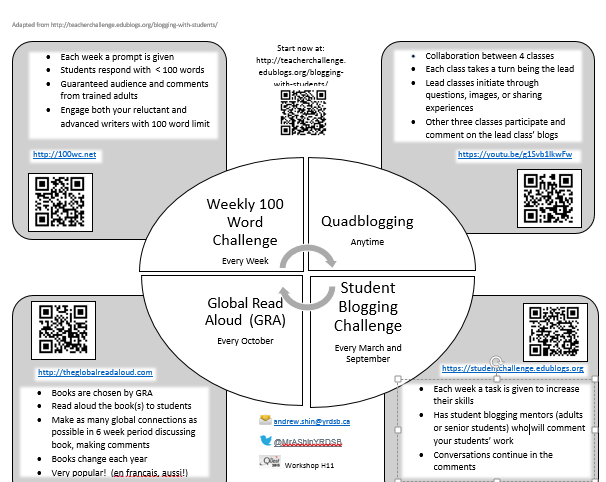
I then outlined a few ways to guarantee student and/or adult comments and views.  This would then encourage some intrinsic motivation to write.  Here's the handout:


I went to George Couros' session at the beginning of the QUEST conference on blogging to see if my presentation would overlap and it didn't.  However, as he was speaking, I realized, I probably should present his point of view. 

You see, I'm an introvert.  And he's like an extrovert.

He's convinced me to blog about my teaching and to create a portfolio of my progress as a teacher.  I am now, putting on my mask of extroversion, as Susan Cain would put it so that I can champion the things that I value the most - education.

As I was presenting my workshop, I started to convince myself of George Couros' words and here I am executing it.  I am now blogging.  My own workshop transformed me.

I hope it changed others as well. 

EDIT:  I just received a general congratulatory note from the organizer of Quest:  "Numerous congratulatory emails sent to me internationally, nationally and locally confirm the excellent planning, preparation, and delivery of Deep Learning in a Digital World. Keynote Speakers share with me their ‘WOW’!!! "  It makes me a little happy to be a part of this conference.

EDIT2:  Here is my QUEST workshop description to save it in my portfolio


Thursday, 19 November 2015

Grade 8 Parents' Night

Hundreds of parents and students descended at our school just to see what Pierre Elliott Trudeau has to offer.  They want to compare our school with the other options out there - the Catholic board or private schools.

I found a few helpful students and we spent most of the time just preparing a room for that would show the parents and students the different math pathways.  Presenting the different math pathways available would benefit the parents and students no matter which school they chose.

We decided to set up the classroom in a way that they could 'walk' the different math pathways available and see where each pathway ends.


As a result, our school has run the transfer course for the first time.  The principal spent some efforts advertising this course at the grade 8 parents night 11 months ago.  She advertised the applied and transfer course pathway as an option for any students that scored a level 2 or below in their grade 8 math scores.  

With the applied + transfer course pathway, the students are exposed to 1.5 credits of math rather than just the 1.0 credits in the academic grade 9 pathway.

There's no way to tell if this applied + transfer course of 1.5 credits is enough to prepare them for grade 10 academic.

This scares me more than their EQAO scores.

Which I guess, in many ways, a good thing.  I'm more concerned about their transition than their EQAO scores.

In my younger years, I'd care too much about their EQAO scores .   I've now realized that if I take care of them as students, the EQAO scores will take care of themselves.  EQAO is subset of what and how they should learn.

I'll be sure to track their success next year.

PS:  The best part of the night was watching a few students explain to the parents what the math clubs and math education is all about.  It's interesting to hear of their experiences.